Thursday, January 16, 2014

Nureyev And Fonteyn


Rudolf Nureyev and Margot Fonteyn in 1965.

Although my parents never caught Fonteyn in performance, they did manage to see Nureyev dance a few times.

My parents first saw Nureyev in 1973. That year, Nureyev appeared in Iowa City with The National Ballet Of Canada in performances of “The Sleeping Beauty”, “Swan Lake” and “La Sylphide”, and my parents drove down to Iowa City to catch two of the performances: “The Sleeping Beauty”; and “Swan Lake”.

Nureyev was still in his prime in 1973, and my parents recall the Iowa City performances with affection. My parents were invited to attend one of the Iowa City rehearsals, which they very much enjoyed—and they witnessed Nureyev, surly and self-obsessed, shove one supernumerary and make a pass at a second (regarding the latter incident, Nureyev was rebuffed).

My parents insist, to this day, that Canadian ballerina Vanessa Harwood in that Iowa City “Swan Lake” outshone Nureyev. Harwood, according to my parents, was the finest Odette/Odile they have ever encountered, finer even than—in alphabetical order—Lesley Collier, Martine van Hamel and Natalia Makarova, all noted exponents of Odette/Odile and all of whom (along with many others) my parents witnessed in the role.

My parents next caught Nureyev in 1978. That year, Nureyev appeared in Saint Louis with the Dutch National Ballet, and my parents flew down to Saint Louis to catch a performance. Again, my parents were invited to attend one of the Saint Louis rehearsals, which they very much enjoyed—and they witnessed Nureyev, surly and self-obsessed, interact contemptuously with choreographers Rudi van Dantzig and Hans van Manen, both of whom had accompanied Dutch National Ballet on its 1978 tour of North America and both of whom had created ballets for Nureyev to be presented in Saint Louis.

Nureyev was no longer in his prime in 1978, and the Dantzig/Manen ballets on the Dutch National Ballet program were not strong. The Saint Louis excursion, according to my parents, was a waste of time.

My parents last caught Nureyev in 1980. That year, Nureyev appeared on the East Coast with the ballet company of Deutsche Oper Berlin, and my parents flew East to catch two of the performances: an evening-length adaptation of the Dostoyevsky novel, “The Idiot”; and a mixed program.

“The Idiot” was an epic ballet, and an epic disaster, hours and hours long, pretentious and preposterous beyond belief. In the final scene of “The Idiot”, Nureyev was called upon to swing back and forth across the stage while attached to a giant tolling bell. The audience found it difficult to suppress laughter; at his curtain calls, Nureyev looked embarrassed.

The mixed bill was a different matter. During the mixed program, Nureyev performed the role of Jean in Birgit Cullberg’s masterpiece, “Miss Julie”—and, according to my parents, Nureyev performed the role superbly. (The role of Jean is acted as much as danced.)

After 1980, my parents never made another effort to catch Nureyev (who, if reviews are to be believed, should have wrapped up his performing career no later than 1977 or 1978)—although my father, on business trips, once came face-to-face with Nureyev at Heathrow Airport and years later again came face-to-face with Nureyev at Zurich Airport.

On both occasions, Nureyev was traveling alone, with nary an attendant or companion in sight.

Nureyev must not have traveled with an entourage—which, given what we know about him, seems in character.

Wednesday, January 15, 2014

Margot Fonteyn

Margot Fonteyn in 1951.

I assume Miss Fonteyn’s ensemble in the photograph is from the House Of Dior, Miss Fonteyn’s preferred designer after World War II, when she abandoned British designers in favor of French designers; the dress, with its geometric neckline, certainly looks like a Dior creation of the early 1950s.

Films of Fonteyn do little to justify her reputation; she probably had to be seen in person to be appreciated.

My parents had only one opportunity to see Fonteyn perform, and they passed it up: a late-career appearance as Lady Capulet in Rudolf Nureyev’s production of “Romeo And Juliet” with the ballet company of Teatro alla Scala. The year was 1981; Fonteyn was sixty-two years old at the time.

It is difficult to separate Fonteyn the legend from Fonteyn the artist. Worshipped in Britain and (for a time) the U.S., Fonteyn was viewed as a joke in Russia. When The Royal Ballet made its first-ever appearance in the U.S.S.R. in the 1950s, Russian critics, the Russian dance establishment and Russian audiences were dumbfounded by Fonteyn’s abject lack of technique. The reception Fonteyn received, from critics and audiences alike, was withering if not scornful.

George Balanchine, too, always viewed Fonteyn as a laughable dancer, once remarking, publicly, that Fonteyn’s feet resembled spoons.

However, at least one Russian, Nureyev, came to adore Fonteyn. The two became lifelong friends.

Since Fonteyn’s death, we have come to learn more about the circumstances of her life and career (and death). For instance, Fonteyn continued to dance long past the time she should have retired from the stage simply because she was in desperate need of money.

Fonteyn died a pauper. For the last ten years of her life, she was—as a practical matter—supported solely by Nureyev, who paid for her living expenses as well as her medical expenses (Fonteyn died after a long battle with cancer).

Nureyev also paid for Fonteyn’s funeral. Nureyev had remained loyal even after his friend’s passing.

Nureyev himself was to die two years later . . . and had no one to perform for himself the role he had performed for Fonteyn.

Nureyev died utterly alone, with only a grasping, money-hungry sister and niece (neither of which he could tolerate) to help ease his path toward death in his final days.

Saturday, January 11, 2014

Stupidity Stands Alone

To accuse another of having weak kidneys, lungs or heart is not a crime; on the other hand, saying someone has a weak brain IS a crime.

To be considered stupid and to be told so is far more painful than being called gluttonous, mendacious, violent, lascivious, lazy or cowardly. Every weakness, every vice has found its defenders, its rhetoric, its ennoblement, its exaltation . . . but stupidity hasn't.

Primo Levi

The Havilland Comet

The first Havilland Comet is rolled out of the factory in 1949.

The world’s first passenger jet was plagued with problems—problems that ended up dooming not only Havilland but the entire British aircraft industry.

The Comet was placed into service on May 2, 1952, with a flight from London to Johannesburg. Below is a photograph of the aircraft involved in that first flight, parked on the tarmac in Entebbe during a refueling stop while en route to Johannesburg.

The first Comet was lost on October 26, 1952.

The second Comet was lost on March 3, 1953.

The third Comet was lost on May 2, 1953.

The fourth Comet was lost on January 10, 1954. The plane lost that day was the same aircraft that undertook the first commercial Comet flight (pictured above).

After the fourth Comet was lost, Winston Churchill ordered the Comet grounded. Despite the fact that only a handful of Comets had been produced and despite the fact that the plane was in very limited service (the Comet had yet to be placed even into trans-Atlantic service), the aircraft was disintegrating under mysterious circumstances. Clearly something was wrong.

Havilland, under great duress, lobbied aggressively, pulling out all the stops (and playing upon the goodwill Havilland had built up during World War II)—and managed to convince the British government that the Comet was indeed airworthy. After ten weeks of grounding, the Comet was re-certified and placed back into service. Flights resumed.

Two weeks later, on April 8, 1954, a fifth Comet was lost—the fifth in eighteen months. At the time, only 22 Comets had been produced; the loss rate approached 25 per cent—for planes that were virtually brand-new.

The result: the Comet was withdrawn from service, permanently, to be completely redesigned, a process that took four years.

In the meantime, Boeing’s 707 and Douglas’s DC-8 were rolled out. Worldwide, airlines cancelled their Comet orders and placed bids for 707s and DC-8s instead.

The Comet effectively was dead. Even the new Comet, which appeared in 1958, was viewed with suspicion by airlines—and airlines, having learned that neither the 707 nor the DC-8 was plagued by safety issues, shunned the redesigned Comet, preferring to stick with Boeing and Douglas aircraft.

Geoffrey de Havilland was bitter over the Comet’s failure. He was also bitter over Boeing’s and Douglas’s successes, always believing that Boeing’s and Douglas’s triumphs were built upon learning from Havilland’s mistakes.

Havilland, in making such claims, was delusional: both the 707 and the DC-8 had long been designed, and were already in production, at the time Comets began falling out of the skies. American aircraft manufacturers, long before World War II, knew all about metal fatigue, faulty riveting techniques and fatal window design, the three engineering flaws that caused the demise of the Comet.

Long after the fact, Havilland wrote about what had happened to his company’s Comets in mid-air. It is not pleasant reading.

A fatigue had started and weakened the cabin structure so that it burst like a blown-up paper bag and was ripped to pieces in a fraction of a second. The passengers had been blown out and killed instantaneously, and the whole structure of the aircraft had broken up and disintegrated in a fraction of a second.

Friday, January 10, 2014

More From The Annals Of Current Transportation

A local train near Stuttgart, captured by my father during his first visit to Europe in 1971.

Thursday, January 09, 2014

“The Public Can Have Any Color It Wants, So Long As It’s Black”

The 1910 Ford Model T.

On the assembly line, Ford Motor Company, because of its state-of-the-art engineering, could produce a Model T, start to finish, in 93 minutes.

At such a hectic pace, the only exterior finish that would dry fast enough was black Japan enamel. Any other exterior finish would have bogged down production.

Monday, January 06, 2014

Fran McCaffery Goes Berserk Again (What Else Is New?)


University Of Iowa basketball coach Fran McCaffery went berserk again yesterday.

What else is new?


Although McCaffery was thrown out of yesterday’s game, at least his wife, Margaret, was not ejected, too—which marks progress of a sort, I suppose. (The University Of Iowa Athletic Department has banned Margaret McCaffery from sitting behind the team bench, an attempt to hold her embarrassing behavior to some manageable level.)


I wonder what goes through this moron’s mind as he tries to attack the game referees.

At least McCaffery’s assistant coaches tried to prevent him from landing punches.


Memo To Sally Mason:

Your basketball coach is an embarrassment to your university.

He is also an embarrassment to the Big Ten Conference as well as to the sport of college basketball.

Do the right thing.

Sunday, January 05, 2014

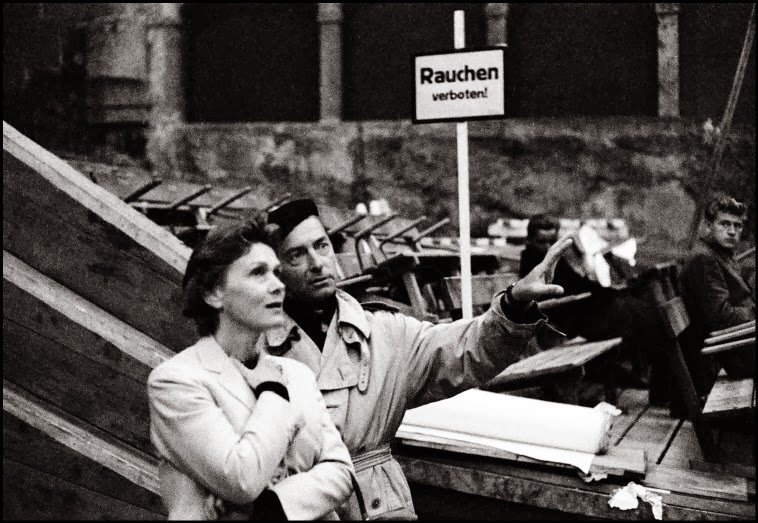
Salzburg 1957: Schwarzkopf And Karajan

Elisabeth Schwarzkopf and Herbert von Karajan in Salzburg in 1957, the year in which Karajan assumed the helm of the Salzburg Festival.

One of the new Salzburg Festival productions in 1957 was Verdi’s “Falstaff”, conducted by Karajan and with Schwarzkopf as Alice Ford.

However, I believe the photograph has nothing to do with that “Falstaff”. More likely the photograph depicts a visit to a rehearsal of Beethoven’s “Fidelio”, also given a new production in 1957 and staged in the Felsenreitschule (the photograph clearly was taken in the Felsenreitschule).

Friday, January 03, 2014

Music Of The Night

I have never attended a performance of the Andrew Lloyd Webber musical, “Phantom Of The Opera”.

I have listened to the two-disc cast album a few times, and I find the score uninteresting and of low quality. My assumption is that the show has been a gargantuan hit not because of the score but because of the spectacular staging by Harold Prince, recreated all over the world since 1986.

Last year producer Cameron Mackintosh unveiled a simplified staging for the U.K. provinces, recreations of the original staging having become cost-prohibitive in recent years. (In the English-speaking world, the original staging may now be seen only in London and New York—and nowhere else.)

At the end of last year, the new, simplified staging was previewed in the U.S. in Providence, Rhode Island, after which it officially opened here in Minneapolis. Word-of-mouth has been very, very positive; ticket sales have been exceptionally robust.

We talked about going—until, as a refresher, we listened to forty minutes of the cast album, which bored us no end and put “paid” to the notion of attending a live performance. The score of “Phantom Of The Opera” is, simply put, cheap swill. I do not understand how anyone can manage to sit through the thing without screaming.

Wednesday, January 01, 2014

17 November 2013: Johnny Orr’s Final Visit To Hilton Coliseum

Johnny Orr, onetime basketball coach first at Michigan and then at Iowa State, takes the floor at Hilton Coliseum in Ames on November 17, 2013, alongside the current Iowa State coach, Fred Hoiberg. The occasion: an Iowa State/Michigan game, a game Iowa State won.

Regarding Iowa State and Michigan, there was no doubt where Orr’s loyalties resided: he became a Cyclone for life from the day he took the Iowa State job in 1980.

Hoiberg, an All-American at Iowa State two years running in the early 1990s, played for Orr and absolutely worshipped the man. After a lengthy pro career (that included several years in Minneapolis first as player for and then as member of management of the Timberwolves), Hoiberg himself turned to coaching. Hoiberg is now in his fourth year as coach at his alma mater, holding down Orr’s old job.

Hoiberg was born and raised in Ames, and his parents still live there. As a consequence, Hoiberg’s popularity in the city has long been at adoration levels. During his playing days, Hoiberg received numerous write-in votes in an election for the Ames mayoralty—which is how Hoiberg acquired his nickname, “The Mayor”.

Of course, Orr was wildly popular in Ames, too. Orr turned around a moribund program, and became a legend in his own lifetime. As soon as Orr arrived in Ames, Hilton Coliseum, America’s most beautiful basketball arena, began selling out every game every season. Hilton Coliseum continued to sell out well past Orr’s 1994 retirement.

Orr died yesterday.

May he rest in peace.