
Showing posts with label Provence 2012. Show all posts
Showing posts with label Provence 2012. Show all posts
Thursday, March 29, 2012

Tuesday, March 27, 2012

Monday, March 26, 2012
Nice
Yesterday my parents enjoyed a beautiful and rewarding day in Nice. It was a perfect final day in France for them.
According to my parents, Nice is an extravagantly beautiful city, far exceeding any expectations they had.
First thing yesterday morning, tour participants were given a guided walking tour of the central part of Nice. They were guided through the streets of the ancient old town as well as escorted through key portions of the city built in the 18th and 19th Centuries. It was during the latter period that Nice’s numerous plazas were created. The spacious plazas lend the city a special Mediterranean beauty.

After the guided walking tour, the tour group embarked on a scenic boat ride that explored Nice’s harbor and the coastal portions of the city.

My parents said that the boat ride was lovely.
Leaving the harbor, the tour group was transported to the Matisse Museum, located in one of Nice’s suburbs. Henri Matisse lived in Nice for much of the last thirty-seven years of his life and gave the museum its founding collection shortly before his death as well as through testamentary gift. The Matisse family has continued to add to the museum’s collection ever since.

The tour group was provided a guided tour of the Matisse Museum, which my parents enjoyed. The building—a villa from the 17th-Century—was beautiful and the displays were beautiful. However, the collection itself is of relative unimportance compared to Matisse holdings in American museums, where the bulk of Matisse’s most important work resides. My parents said that the Matisse collection in Nice was a minor footnote compared to the Matisse collections held by such American institutions as the Baltimore Museum Of Art or The Barnes Foundation.
From the Matisse Museum, tour participants were transported back to the hotel, with the rest of the afternoon free.
As soon as the tour group was dropped back at the hotel, my parents immediately proceeded to Saint Nicholas Orthodox Cathedral, the most important Russian Orthodox Cathedral outside Russia.

Saint Nicholas was built during the period in which Russian nobility and members of The Imperial Russian Court spent significant portions of the year in Nice, a period that lasted from the mid-19th Century until The Russian Revolution. Tsar Nicholas II himself funded construction of the Cathedral, which opened in 1912.
The Cathedral opens at 2:30 p.m. on Saturdays, and my parents arrived a few minutes before opening. They walked around the exterior and then went inside for a short visit. My parents said that—to the best of their recollections—the interior of Saint Nicholas Orthodox Cathedral in Nice looked exactly like the interior of Saint Alexander Nevsky Cathedral in Paris, which had been erected fifty-one years before the Nice Cathedral was consecrated.
From Saint Nicholas Orthodox Cathedral my parents went to Nice’s primary art museum, Musée des Beaux-Arts, which houses and displays paintings and sculpture from the last five centuries. Musée des Beaux-Arts is housed in the former villa of a Russian princess, who had commissioned the building in 1878. The building is yet another indication of the important Russian community that in Tsarist times had spent much of the year in Nice.

Since the museum remains open until 6:00 p.m., my parents had sufficient time to examine the permanent collection of paintings and sculpture to their satisfaction. The collection, overwhelmingly French, is neither particularly large nor particularly notable, and is very heavy on the 19th Century, but my parents very much enjoyed their visit to Musée des Beaux-Arts.
From the museum my parents proceeded to a designated restaurant for what was described as a “farewell dinner” for the tour group.
The dinner was excellent, even festive. Practically everyone that participated in the tour was sorry to see the tour end and sorry to see fellow travelers head their separate ways.
My parents had a splendid time in Provence—it was a perfect ten-day getaway for them—and they would like to return to Avignon and Nice, as they barely scratched the surface of either city. My parents said that Nice, like Avignon, is probably worth ten days of exploration.
According to my parents, Nice is an extravagantly beautiful city, far exceeding any expectations they had.
First thing yesterday morning, tour participants were given a guided walking tour of the central part of Nice. They were guided through the streets of the ancient old town as well as escorted through key portions of the city built in the 18th and 19th Centuries. It was during the latter period that Nice’s numerous plazas were created. The spacious plazas lend the city a special Mediterranean beauty.

After the guided walking tour, the tour group embarked on a scenic boat ride that explored Nice’s harbor and the coastal portions of the city.

My parents said that the boat ride was lovely.
Leaving the harbor, the tour group was transported to the Matisse Museum, located in one of Nice’s suburbs. Henri Matisse lived in Nice for much of the last thirty-seven years of his life and gave the museum its founding collection shortly before his death as well as through testamentary gift. The Matisse family has continued to add to the museum’s collection ever since.

The tour group was provided a guided tour of the Matisse Museum, which my parents enjoyed. The building—a villa from the 17th-Century—was beautiful and the displays were beautiful. However, the collection itself is of relative unimportance compared to Matisse holdings in American museums, where the bulk of Matisse’s most important work resides. My parents said that the Matisse collection in Nice was a minor footnote compared to the Matisse collections held by such American institutions as the Baltimore Museum Of Art or The Barnes Foundation.
From the Matisse Museum, tour participants were transported back to the hotel, with the rest of the afternoon free.
As soon as the tour group was dropped back at the hotel, my parents immediately proceeded to Saint Nicholas Orthodox Cathedral, the most important Russian Orthodox Cathedral outside Russia.

Saint Nicholas was built during the period in which Russian nobility and members of The Imperial Russian Court spent significant portions of the year in Nice, a period that lasted from the mid-19th Century until The Russian Revolution. Tsar Nicholas II himself funded construction of the Cathedral, which opened in 1912.
The Cathedral opens at 2:30 p.m. on Saturdays, and my parents arrived a few minutes before opening. They walked around the exterior and then went inside for a short visit. My parents said that—to the best of their recollections—the interior of Saint Nicholas Orthodox Cathedral in Nice looked exactly like the interior of Saint Alexander Nevsky Cathedral in Paris, which had been erected fifty-one years before the Nice Cathedral was consecrated.
From Saint Nicholas Orthodox Cathedral my parents went to Nice’s primary art museum, Musée des Beaux-Arts, which houses and displays paintings and sculpture from the last five centuries. Musée des Beaux-Arts is housed in the former villa of a Russian princess, who had commissioned the building in 1878. The building is yet another indication of the important Russian community that in Tsarist times had spent much of the year in Nice.

Since the museum remains open until 6:00 p.m., my parents had sufficient time to examine the permanent collection of paintings and sculpture to their satisfaction. The collection, overwhelmingly French, is neither particularly large nor particularly notable, and is very heavy on the 19th Century, but my parents very much enjoyed their visit to Musée des Beaux-Arts.
From the museum my parents proceeded to a designated restaurant for what was described as a “farewell dinner” for the tour group.
The dinner was excellent, even festive. Practically everyone that participated in the tour was sorry to see the tour end and sorry to see fellow travelers head their separate ways.
My parents had a splendid time in Provence—it was a perfect ten-day getaway for them—and they would like to return to Avignon and Nice, as they barely scratched the surface of either city. My parents said that Nice, like Avignon, is probably worth ten days of exploration.
Saturday, March 24, 2012
Antibes, Grasse, Nice
This morning the tour participants left Avignon and headed toward Nice, making two stops along the way.
After a drive lasting more than two hours, the group first arrived at Antibes, a coastal town on the French Riviera.
Tour participants were given two-and-one-half hours to explore the town of Antibes.
My parents simply walked around the old town, still fully enclosed by centuries-old ramparts, and enjoyed a nice lunch.
Antibes is home to a Picasso museum, one of many Picasso museums in Europe, which my parents might have visited had the Antibes Picasso museum not been closed for renovation. Antibes is also home to a noted naval museum, but the naval museum is in a distant part of town, and my parents chose not to venture beyond the old town.
My parents did not find Antibes to be particularly interesting or particularly beautiful. The old town, with its narrow streets, was unduly commercial and unpleasantly dirty, and there were few buildings of interest to be found.
Antibes was at its best from a distance, looking at one rampart of the old town from another.

From Antibes, the tour group was transported to nearby Grasse.
Grasse is the perfume capital of the world, and the tour group was taken directly to the Galimard Parfumerie, where a one-hour guided tour was conducted.
The guided tour was a first-class affair in every way, and my parents—unexpectedly—found themselves fascinated by the experience.
The tour began with a visit to the on-site museum, at which antique equipment for producing scents was on display. The tour continued with a visit to the modern factory, after which the tour group visited the laboratory, surely as complex as laboratories at DuPont. The process of extracting scents from flowers, plants, woods and other raw materials was explained in depth.

At the conclusion of the guided tour, there was a two-hour “workshop” with scent experts. During the workshop, tour participants were requested to find their favorite “essences” and create their own personal perfumes. At the conclusion of the workshop, participants were presented with tiny souvenir bottles of their own personal creations.
Tour participants learned that perfumes have “architectures”, just like music. A good perfume must possess a good top note, a good middle note, and a good base note (and, in perfume terminology, it is “base”, not “bass”), all chosen from one of 127 available notes—and all three chosen notes must coexist in the right proportions in order to achieve a rounded, harmonious result.
All of this was explained by an expert “Nose”—a person trained to possess the very highest olfactory skills—who assisted each tour participant in the perfume-creation process.
My parents, to their surprise, found the workshop to be very informative—and a lot of fun. The Galimard personnel were exceedingly knowledgeable, exceedingly professional, exceedingly French and exceedingly chic. The afternoon was, more or less, an unexpected delight, a once-in-a-lifetime experience for persons having no inherent interest in the subject of scent creation.
After the afternoon-long visit to the Galimard Parfumerie, the tour group was transported to Nice, where it will spend the next two nights.
The tour hotel is right in the center of Nice, in contrast to the tour hotel in Avignon, and my parents said the hotel is quite fashionable.

After settling in, my parents and three other couples walked around Nice for ninety minutes and located a restaurant for dinner.
My parents report that Nice is a gorgeous city.
After a drive lasting more than two hours, the group first arrived at Antibes, a coastal town on the French Riviera.
Tour participants were given two-and-one-half hours to explore the town of Antibes.
My parents simply walked around the old town, still fully enclosed by centuries-old ramparts, and enjoyed a nice lunch.
Antibes is home to a Picasso museum, one of many Picasso museums in Europe, which my parents might have visited had the Antibes Picasso museum not been closed for renovation. Antibes is also home to a noted naval museum, but the naval museum is in a distant part of town, and my parents chose not to venture beyond the old town.
My parents did not find Antibes to be particularly interesting or particularly beautiful. The old town, with its narrow streets, was unduly commercial and unpleasantly dirty, and there were few buildings of interest to be found.
Antibes was at its best from a distance, looking at one rampart of the old town from another.

From Antibes, the tour group was transported to nearby Grasse.
Grasse is the perfume capital of the world, and the tour group was taken directly to the Galimard Parfumerie, where a one-hour guided tour was conducted.
The guided tour was a first-class affair in every way, and my parents—unexpectedly—found themselves fascinated by the experience.
The tour began with a visit to the on-site museum, at which antique equipment for producing scents was on display. The tour continued with a visit to the modern factory, after which the tour group visited the laboratory, surely as complex as laboratories at DuPont. The process of extracting scents from flowers, plants, woods and other raw materials was explained in depth.

At the conclusion of the guided tour, there was a two-hour “workshop” with scent experts. During the workshop, tour participants were requested to find their favorite “essences” and create their own personal perfumes. At the conclusion of the workshop, participants were presented with tiny souvenir bottles of their own personal creations.
Tour participants learned that perfumes have “architectures”, just like music. A good perfume must possess a good top note, a good middle note, and a good base note (and, in perfume terminology, it is “base”, not “bass”), all chosen from one of 127 available notes—and all three chosen notes must coexist in the right proportions in order to achieve a rounded, harmonious result.
All of this was explained by an expert “Nose”—a person trained to possess the very highest olfactory skills—who assisted each tour participant in the perfume-creation process.
My parents, to their surprise, found the workshop to be very informative—and a lot of fun. The Galimard personnel were exceedingly knowledgeable, exceedingly professional, exceedingly French and exceedingly chic. The afternoon was, more or less, an unexpected delight, a once-in-a-lifetime experience for persons having no inherent interest in the subject of scent creation.
After the afternoon-long visit to the Galimard Parfumerie, the tour group was transported to Nice, where it will spend the next two nights.
The tour hotel is right in the center of Nice, in contrast to the tour hotel in Avignon, and my parents said the hotel is quite fashionable.

After settling in, my parents and three other couples walked around Nice for ninety minutes and located a restaurant for dinner.
My parents report that Nice is a gorgeous city.
Friday, March 23, 2012
Les Baux-de-Provence, Saint-Rémy-de-Provence
One of the reasons my parents took a guided tour of Provence rather than undertake their own independent trip to Provence is that they wanted to leave all arrangements to someone else.
They wanted to see the highlights of Provence without pouring over guidebooks and without having to research hotels and transport and such. Ten relaxing days in a new place is what they were looking for, with all responsibilities in someone else’s hands.
The downside of such trips is that things must be endured that may not be of interest to all travelers.
My parents had to suffer through another unrewarding activity today—and they knew, signing up for the tour, that certain items on the itinerary did not sound appealing. That is the price they paid for participating in an organized excursion.
Late this morning, the tour group was transported to an olive estate, and given an exhaustive tour of the estate’s olive groves and the on-site olive-oil production facilities. For my parents, it was the low point of the tour thus far, even more boring than yesterday’s visit to The Lavender Museum. After today’s visit to the olive estate, my father said, “Today was my first high school field trip since 1964, when Pella High School sent its seniors to Des Moines to visit the State Capitol and meet the Governor. Des Moines was more fun.”
At least my parents found today’s first and last stops to be worthwhile.
The day began with a trip through scenic backcountry roads to the hilltop town of Les Baux-de-Provence, situated in the Alpilles Mountains. Les Baux-de-Provence is a much more rustic (and much smaller) version of the hilltop town of Gordes, which the tour group had visited the previous afternoon.

There is a ruined castle at the top of the small mountain on which the town of Les Baux-de-Provence is built. Otherwise, Les Baux-de-Provence is nothing more than a few dozen small buildings built on a series of rock outcroppings. The population of the town is fewer than 500 persons. The town exists to attract tourism—and 1.5 million tourists, overwhelmingly French, visit Les Baux-de-Provence each year.
The tour group spent only ninety minutes in Les Baux-de-Provence. That was more than ample time to walk the entire town.
The day ended with an afternoon visit to Saint-Rémy-de-Provence. Tour participants were first given a guided tour of the town’s famous Roman ruins, after which they were allowed ninety minutes to explore the town itself.
My parents said that the Roman ruins at Saint-Rémy-de-Provence were magnificent. They are supposed to be among the best-preserved Roman ruins anywhere.

The ruins, at the edge of the current town, were not discovered until 1921. Countless acres have already been uncovered, but archeologists believe they have discovered only a small fraction of the riches to be unearthed over the next century or two.
The ruins at Saint-Rémy-de-Provence are in excellent condition because the German invaders that captured the town in 260 A.D. never destroyed it. The Germans drove out the Roman population of the Roman town known as Glanum, and then moved on to other conquests, never bothering to vandalize the town.
Many of the Glanum ruins from The Roman Period are remarkable, such as a street of residences uncovered in recent years, damaged only by weather and the ravages of time.

My parents greatly enjoyed the tour of the Roman ruins, which they said was excellent, and they enjoyed their stroll in the town of Saint-Rémy-de-Provence.
After today’s sightseeing, the tour group returned to Avignon for one final night.
Tomorrow the tour will move on to Nice.
They wanted to see the highlights of Provence without pouring over guidebooks and without having to research hotels and transport and such. Ten relaxing days in a new place is what they were looking for, with all responsibilities in someone else’s hands.
The downside of such trips is that things must be endured that may not be of interest to all travelers.
My parents had to suffer through another unrewarding activity today—and they knew, signing up for the tour, that certain items on the itinerary did not sound appealing. That is the price they paid for participating in an organized excursion.
Late this morning, the tour group was transported to an olive estate, and given an exhaustive tour of the estate’s olive groves and the on-site olive-oil production facilities. For my parents, it was the low point of the tour thus far, even more boring than yesterday’s visit to The Lavender Museum. After today’s visit to the olive estate, my father said, “Today was my first high school field trip since 1964, when Pella High School sent its seniors to Des Moines to visit the State Capitol and meet the Governor. Des Moines was more fun.”
At least my parents found today’s first and last stops to be worthwhile.
The day began with a trip through scenic backcountry roads to the hilltop town of Les Baux-de-Provence, situated in the Alpilles Mountains. Les Baux-de-Provence is a much more rustic (and much smaller) version of the hilltop town of Gordes, which the tour group had visited the previous afternoon.

There is a ruined castle at the top of the small mountain on which the town of Les Baux-de-Provence is built. Otherwise, Les Baux-de-Provence is nothing more than a few dozen small buildings built on a series of rock outcroppings. The population of the town is fewer than 500 persons. The town exists to attract tourism—and 1.5 million tourists, overwhelmingly French, visit Les Baux-de-Provence each year.
The tour group spent only ninety minutes in Les Baux-de-Provence. That was more than ample time to walk the entire town.
The day ended with an afternoon visit to Saint-Rémy-de-Provence. Tour participants were first given a guided tour of the town’s famous Roman ruins, after which they were allowed ninety minutes to explore the town itself.
My parents said that the Roman ruins at Saint-Rémy-de-Provence were magnificent. They are supposed to be among the best-preserved Roman ruins anywhere.

The ruins, at the edge of the current town, were not discovered until 1921. Countless acres have already been uncovered, but archeologists believe they have discovered only a small fraction of the riches to be unearthed over the next century or two.
The ruins at Saint-Rémy-de-Provence are in excellent condition because the German invaders that captured the town in 260 A.D. never destroyed it. The Germans drove out the Roman population of the Roman town known as Glanum, and then moved on to other conquests, never bothering to vandalize the town.
Many of the Glanum ruins from The Roman Period are remarkable, such as a street of residences uncovered in recent years, damaged only by weather and the ravages of time.
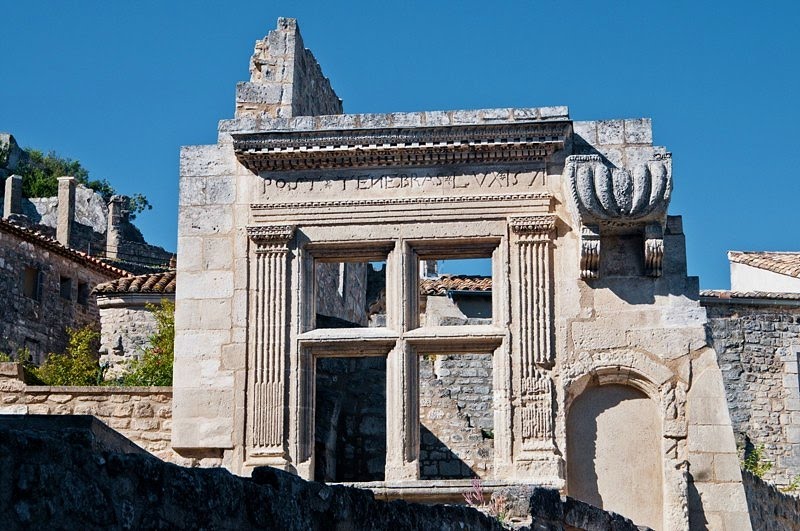
My parents greatly enjoyed the tour of the Roman ruins, which they said was excellent, and they enjoyed their stroll in the town of Saint-Rémy-de-Provence.
After today’s sightseeing, the tour group returned to Avignon for one final night.
Tomorrow the tour will move on to Nice.
Thursday, March 22, 2012
L’Isle-sur-la-Sorgue, Lubéron National Park, Gordes
For my parents, today began well and ended well—but the middle of the day was rather a dud.
This morning, tour participants were transported to L’Isle-sur-la-Sorgue, a small town situated on an island in the middle of the Sorgue River.
L’Isle-sur-la-Sorgue is known for its many canals as well as for its many antique shops.
Participants were requested to focus on the town’s open-air market (with the expectation that they buy things)—but the town proved so lovely that virtually everyone in the tour group quickly departed the open-air market and strolled the streets and canals of the town. Flowers were in bloom, the day was sunny, and the bright colors decorating the town’s buildings gave the morning a joyful, even festive, air.

Despite the fact that there was absolutely nothing of historic interest in the town, my parents loved their visit to L’Isle-sur-la-Sorgue.
From L’Isle-sur-la-Sorgue, the tour group was transported into Lubéron National Park, a Provencal nature reserve set amidst three small mountain chains.
In the middle of the park, the tour group was deposited at The Lavender Museum, a museum devoted to lavender and its history, cultivation, harvest, distillation and production.
The Lavender Museum is a family-owned enterprise not all that dissimilar to such family enterprises in the United States. Like U.S. variants of this noxious lineage, The Lavender Museum was little more than a haphazard collection of junk.
Not only were tour participants forced to spend time at The Lavender Museum, tour participants were also required to endure a lengthy and near-unbearable guided tour by one of the museum’s owners—“just the sort of thing for people who like this sort of thing”, according to my father.
During the guided tour, the Lavender Museum guide pointed out, a hundred times, that the museum owns the largest collection of copper stills for lavender in the world. After the guide's 90th iteration of this fact, my father turned to my mother and said, in exasperation, “Well . . . I would certainly hope so.”
Sadly, the copper stills and copper colanders were by far the most interesting items on display at The Lavender Museum. Nothing else was of any interest whatsoever.
To make matters worse, the tour group was made to sit through not one but two insufferable videos. When the museum guide started the second video, my father turned to my mother and asked, “Don’t we get time off for good behavior?”
At the conclusion of the guided tour of the museum, tour participants were made to spend twenty-five minutes in the requisite gift shop. The men in the group were particularly irritated by this, and started openly cracking jokes, comparing The Lavender Museum to the world’s largest ball of twine or a temple devoted to linoleum.
After The Lavender Museum, the tour group was driven through more of Lubéron National Park, which was pleasant enough, and then deposited at the base of Gordes, an ancient hilltop town situated on the side and summit of a small mountain.
Gordes, according to my parents, made the day worthwhile.
The buildings of Gordes, set into hillside cliffs, are made of a uniform white stone that looks yellow from a distance. Italian poplar trees and carefully-conceived greenery break the monotony of the whiteness of the stone.

Narrow cobble streets wind through the town, taking visitors to the top, where rests an ancient castle, church and other buildings—and where visitors may enjoy marvelous views over the plain below.
According to my parents, Gordes was breathtakingly beautiful—which probably is why it is the most-visited small town in France.
My parents walked the winding narrow streets from the base to the top, stopping for a coffee and pastry along the way, and they retraced their steps on the way down, stopping for a cappuccino on the return portion of their stroll.
It was a beautiful way to spend an afternoon.
This morning, tour participants were transported to L’Isle-sur-la-Sorgue, a small town situated on an island in the middle of the Sorgue River.
L’Isle-sur-la-Sorgue is known for its many canals as well as for its many antique shops.
Participants were requested to focus on the town’s open-air market (with the expectation that they buy things)—but the town proved so lovely that virtually everyone in the tour group quickly departed the open-air market and strolled the streets and canals of the town. Flowers were in bloom, the day was sunny, and the bright colors decorating the town’s buildings gave the morning a joyful, even festive, air.

Despite the fact that there was absolutely nothing of historic interest in the town, my parents loved their visit to L’Isle-sur-la-Sorgue.
From L’Isle-sur-la-Sorgue, the tour group was transported into Lubéron National Park, a Provencal nature reserve set amidst three small mountain chains.
In the middle of the park, the tour group was deposited at The Lavender Museum, a museum devoted to lavender and its history, cultivation, harvest, distillation and production.
The Lavender Museum is a family-owned enterprise not all that dissimilar to such family enterprises in the United States. Like U.S. variants of this noxious lineage, The Lavender Museum was little more than a haphazard collection of junk.
Not only were tour participants forced to spend time at The Lavender Museum, tour participants were also required to endure a lengthy and near-unbearable guided tour by one of the museum’s owners—“just the sort of thing for people who like this sort of thing”, according to my father.
During the guided tour, the Lavender Museum guide pointed out, a hundred times, that the museum owns the largest collection of copper stills for lavender in the world. After the guide's 90th iteration of this fact, my father turned to my mother and said, in exasperation, “Well . . . I would certainly hope so.”
Sadly, the copper stills and copper colanders were by far the most interesting items on display at The Lavender Museum. Nothing else was of any interest whatsoever.
To make matters worse, the tour group was made to sit through not one but two insufferable videos. When the museum guide started the second video, my father turned to my mother and asked, “Don’t we get time off for good behavior?”
At the conclusion of the guided tour of the museum, tour participants were made to spend twenty-five minutes in the requisite gift shop. The men in the group were particularly irritated by this, and started openly cracking jokes, comparing The Lavender Museum to the world’s largest ball of twine or a temple devoted to linoleum.
After The Lavender Museum, the tour group was driven through more of Lubéron National Park, which was pleasant enough, and then deposited at the base of Gordes, an ancient hilltop town situated on the side and summit of a small mountain.
Gordes, according to my parents, made the day worthwhile.
The buildings of Gordes, set into hillside cliffs, are made of a uniform white stone that looks yellow from a distance. Italian poplar trees and carefully-conceived greenery break the monotony of the whiteness of the stone.

Narrow cobble streets wind through the town, taking visitors to the top, where rests an ancient castle, church and other buildings—and where visitors may enjoy marvelous views over the plain below.
According to my parents, Gordes was breathtakingly beautiful—which probably is why it is the most-visited small town in France.
My parents walked the winding narrow streets from the base to the top, stopping for a coffee and pastry along the way, and they retraced their steps on the way down, stopping for a cappuccino on the return portion of their stroll.
It was a beautiful way to spend an afternoon.
Wednesday, March 21, 2012
Arles And The Camargue Nature Reserve
The Avignon hotel at which my parents’ tour group is staying is a Best Western property, a fact that somewhat surprised my parents.
The hotel is perfectly satisfactory. Best Western properties in France are superior to Best Western properties in the U.S.

This morning the tour participants were transported to Arles.
Upon arrival, the first item on the itinerary was a lecture on the subject of Vincent Van Gogh, who had lived for a time in Arles. The lecture, prepared for a general audience and delivered by a so-called art expert, was not as gruesome as my parents had feared.
After the lecture, the tour group was given a guided walking tour of Arles.
Arles, a city of some importance in The Roman Period, is most notable for its Roman ruins. The Roman Amphitheater is considered the most notable structure in Arles, although the Roman Theater is probably of equal historic interest. Both facilities remain in use to this day.
The Roman Amphitheater, in amazing condition, is sizable—its capacity is 20,000 persons—but nowhere near as large as the amphitheaters in Rome, Verona and throughout the Middle East. The amphitheater is home to many events, including bullfights. It had previously been unknown to me that bullfights were legal in France.

The Roman Theater is now a venue for various outdoor theater and music events.

According to my parents, Arles was unremarkable except for its Roman ruins.
After a morning in Arles, the tour group was transported to Camargue and treated to what was billed as an authentic Arlésien lunch at a rustic farmhouse.
After lunch, the tour group was driven through the Camargue Nature Reserve in the company of a so-called nature expert, who lectured incessantly throughout the afternoon on the local flora and fauna as well as the wild horses and wild bulls and wild buffaloes that roam the Camargue reserve. Within the nature reserve, the tour group made several stops: at a rice paddy; at a section of wetlands; at the habitat of a family of flamingos; and at a salt flat, where the group was given an interminable guided tour.
My parents, needless to say, were not riveted by the afternoon. In fact, my parents said they were praying for the nature expert’s microphone to break. At day’s end, my parents said they wished they had remained in Avignon, and visited churches and museums.
However, they had not wanted to miss out on Arles.
The hotel is perfectly satisfactory. Best Western properties in France are superior to Best Western properties in the U.S.

This morning the tour participants were transported to Arles.
Upon arrival, the first item on the itinerary was a lecture on the subject of Vincent Van Gogh, who had lived for a time in Arles. The lecture, prepared for a general audience and delivered by a so-called art expert, was not as gruesome as my parents had feared.
After the lecture, the tour group was given a guided walking tour of Arles.
Arles, a city of some importance in The Roman Period, is most notable for its Roman ruins. The Roman Amphitheater is considered the most notable structure in Arles, although the Roman Theater is probably of equal historic interest. Both facilities remain in use to this day.
The Roman Amphitheater, in amazing condition, is sizable—its capacity is 20,000 persons—but nowhere near as large as the amphitheaters in Rome, Verona and throughout the Middle East. The amphitheater is home to many events, including bullfights. It had previously been unknown to me that bullfights were legal in France.

The Roman Theater is now a venue for various outdoor theater and music events.

According to my parents, Arles was unremarkable except for its Roman ruins.
After a morning in Arles, the tour group was transported to Camargue and treated to what was billed as an authentic Arlésien lunch at a rustic farmhouse.
After lunch, the tour group was driven through the Camargue Nature Reserve in the company of a so-called nature expert, who lectured incessantly throughout the afternoon on the local flora and fauna as well as the wild horses and wild bulls and wild buffaloes that roam the Camargue reserve. Within the nature reserve, the tour group made several stops: at a rice paddy; at a section of wetlands; at the habitat of a family of flamingos; and at a salt flat, where the group was given an interminable guided tour.
My parents, needless to say, were not riveted by the afternoon. In fact, my parents said they were praying for the nature expert’s microphone to break. At day’s end, my parents said they wished they had remained in Avignon, and visited churches and museums.
However, they had not wanted to miss out on Arles.
Tuesday, March 20, 2012
Avignon
Early this morning, my parents and the other tour participants were transported to Avignon.
The journey took little over an hour.
En route, the tour guides warned tour participants about crime in Avignon, much of it directed against tourists. Avignon has suffered a crime wave against tourists going back to the late 1980s, and local authorities have proven themselves unable or unwilling to address the problem. Violent muggings of tourists in Avignon have become commonplace—and tour participants were advised to hide all valuables and to remain in groups.
Upon arrival, the tour group was given a guided walking tour of the walled portion of the ancient city.
My parents were enthralled. They described Avignon as “stunningly beautiful” and “itself worth crossing the ocean to see” and “the highlight of the trip thus far”—which means that my parents like Avignon very much.
The old Medieval ramparts of Avignon remain in place, one of the few cities in Europe of which this may be said. Twelve thousand persons currently reside within the Medieval ramparts of Avignon, signifying that old Avignon was a town of some size.
Of course, Avignon is all about its papal legacy—and, after the walking tour of the walled town had been completed, the tour group visited Avignon’s Papal Palace, seen here in a stock tourism photograph taken from the air, the only way to capture an image of the giant complex in its entirety.

The stock tourism photo not only presents the Papal Palace whole, it also shows how the Papal Palace completely dominates the town of Avignon.
(Avignon’s Cathedral, with a gilded statue atop its tower, may be seen immediately behind the Papal Palace. Part of The Bridge Of Avignon may be seen in the lower-left portion of the photograph.)
Avignon was seat of The Papacy between 1309 and 1377. Construction of the giant Papal Palace was begun in 1355 and completed less than twenty years later, an extraordinary achievement given 14th-Century technology.
The tour group was given a special guided tour of the palace supposedly unavailable to members of the general public.
Once again my parents were enthralled. The various churches and chapels inside the palace, the elaborate public passageways and stairwells, the lavish private apartments, the stately cloisters and courtyards: all were magnificent, brilliantly-designed and brilliantly-executed.
The Papal Palace was clearly intended to impress upon visitors the power and wealth of The Roman Catholic Church. Everything was on the grandest possible scale. Even the Pope’s private chapel, designed for the Pontiff’s exclusive personal use, was enormous.

The Papal Palace tour was ninety minutes in duration; at its conclusion, my parents believed they had barely scratched the surface—and vowed to return.
After the visit to the Papal Palace, the tour group was guided to a specialty cheese shop noted for “artisanal” cheeses. The tour group was allowed to sample any of hundreds of varieties of cheeses—and members of the tour group were expected to buy cheeses as well. Perhaps simply to demonstrate that they were good sports, my parents purchased four different cheeses for shipment to the U.S.
I doubt there will be a recurrence of what happened the last time my parents bought a unique food item in Europe.
I recall well the two boxes of marzipan my parents purchased three years ago in Southern Portugal under similar circumstances. Once the marzipan had been shipped home to Minneapolis, everyone took a bite—and called it a day (except for my nephew, who spit his marzipan out). Not even the dog would eat the marzipan.
Once tour participants were allowed to escape the cheese shop, they had the afternoon to themselves, free to explore Avignon on their own.
My parents had wanted to visit Musee Calvet, which is supposed to be an excellent art museum, but Musee Calvet is closed on Tuesdays. Consequently, my parents decided to devote their time to visiting Avignon’s Cathedral and Avignon’s famous bridge, after which they would spend any remaining time simply walking around the town.
Avignon’s Cathedral was in place almost two centuries before the Papal Palace was erected.

Almost overwhelmed by the mighty papal complex next door, Avignon’s Cathedral is an important structure in its own right.
The base of Avignon’s Cathedral is Romanesque, built in the 12th Century, and the interior remains largely Romanesque. However, the Cathedral’s exterior has been much-altered and much-expanded in succeeding centuries. The tower was not begun until the 15th Century and was not completed until the 19th Century. A gilded statue of the Virgin Mary lies atop the tower; it is the highest point in Avignon.
The interior is restrained, typical of Romanesque ecclesiastical architecture.

Numerous monuments are situated within the Cathedral, including at least two tombs of Popes who served during the years Avignon was seat of The Papacy.
Below the hilltop on which sits the Papal Palace and Avignon’s Cathedral lies The Rhone River. Immediately at the base of the Papal Palace and Avignon’s Cathedral is the famous Bridge Of Avignon.

The Bridge Of Avignon was constructed between 1171 and 1185. The original bridge was almost 3000 feet long, crossing an island and both channels of the Rhone, and was made of twenty-two arches. Over the intervening centuries, all but four of the arches have collapsed. One of the surviving arches supports a chapel devoted to Saint Benezet, the young man who planned and participated in the construction of the bridge.
The Bridge Of Avignon, whose pathway is only twelve feet wide, was a vital part of the Medieval transportation system not only within France but between Spain and Italy as well. For centuries, all overland travel between Spain and Italy involved a crossing of The Bridge Of Avignon.
Everyone who travels to Avignon walks the famous bridge jutting out into The Rhone—and my parents did, too.

Having explored Avignon’s Cathedral and Avignon’s famous bridge, my parents spent the rest of the afternoon exploring the town. They passed countless ancient churches and buildings of great interest. It was all too much for them to take in. My parents said it would take ten days to explore Avignon to satisfaction.
Early in the evening, my parents proceeded to a designated restaurant in the center of town, where tour members were to participate in a demonstration of authentic Provencal cooking by a renowned Provencal chef. According to my father, the cooking demonstration was “not unnecessarily painful”, which means that my parents survived the activity.
Quite naturally, at the end of the cooking demonstration, tour participants were treated to a Provencal dinner in the same restaurant. My parents said the food was quite good.
It was only after the Provencal dinner had concluded that tour members were finally transported to the hotel, located on the city’s outskirts (and across The Rhone River from Avignon), where the tour group will spend the next four nights.
The journey took little over an hour.
En route, the tour guides warned tour participants about crime in Avignon, much of it directed against tourists. Avignon has suffered a crime wave against tourists going back to the late 1980s, and local authorities have proven themselves unable or unwilling to address the problem. Violent muggings of tourists in Avignon have become commonplace—and tour participants were advised to hide all valuables and to remain in groups.
Upon arrival, the tour group was given a guided walking tour of the walled portion of the ancient city.
My parents were enthralled. They described Avignon as “stunningly beautiful” and “itself worth crossing the ocean to see” and “the highlight of the trip thus far”—which means that my parents like Avignon very much.
The old Medieval ramparts of Avignon remain in place, one of the few cities in Europe of which this may be said. Twelve thousand persons currently reside within the Medieval ramparts of Avignon, signifying that old Avignon was a town of some size.
Of course, Avignon is all about its papal legacy—and, after the walking tour of the walled town had been completed, the tour group visited Avignon’s Papal Palace, seen here in a stock tourism photograph taken from the air, the only way to capture an image of the giant complex in its entirety.

The stock tourism photo not only presents the Papal Palace whole, it also shows how the Papal Palace completely dominates the town of Avignon.
(Avignon’s Cathedral, with a gilded statue atop its tower, may be seen immediately behind the Papal Palace. Part of The Bridge Of Avignon may be seen in the lower-left portion of the photograph.)
Avignon was seat of The Papacy between 1309 and 1377. Construction of the giant Papal Palace was begun in 1355 and completed less than twenty years later, an extraordinary achievement given 14th-Century technology.
The tour group was given a special guided tour of the palace supposedly unavailable to members of the general public.
Once again my parents were enthralled. The various churches and chapels inside the palace, the elaborate public passageways and stairwells, the lavish private apartments, the stately cloisters and courtyards: all were magnificent, brilliantly-designed and brilliantly-executed.
The Papal Palace was clearly intended to impress upon visitors the power and wealth of The Roman Catholic Church. Everything was on the grandest possible scale. Even the Pope’s private chapel, designed for the Pontiff’s exclusive personal use, was enormous.

The Papal Palace tour was ninety minutes in duration; at its conclusion, my parents believed they had barely scratched the surface—and vowed to return.
After the visit to the Papal Palace, the tour group was guided to a specialty cheese shop noted for “artisanal” cheeses. The tour group was allowed to sample any of hundreds of varieties of cheeses—and members of the tour group were expected to buy cheeses as well. Perhaps simply to demonstrate that they were good sports, my parents purchased four different cheeses for shipment to the U.S.
I doubt there will be a recurrence of what happened the last time my parents bought a unique food item in Europe.
I recall well the two boxes of marzipan my parents purchased three years ago in Southern Portugal under similar circumstances. Once the marzipan had been shipped home to Minneapolis, everyone took a bite—and called it a day (except for my nephew, who spit his marzipan out). Not even the dog would eat the marzipan.
Once tour participants were allowed to escape the cheese shop, they had the afternoon to themselves, free to explore Avignon on their own.
My parents had wanted to visit Musee Calvet, which is supposed to be an excellent art museum, but Musee Calvet is closed on Tuesdays. Consequently, my parents decided to devote their time to visiting Avignon’s Cathedral and Avignon’s famous bridge, after which they would spend any remaining time simply walking around the town.
Avignon’s Cathedral was in place almost two centuries before the Papal Palace was erected.

Almost overwhelmed by the mighty papal complex next door, Avignon’s Cathedral is an important structure in its own right.
The base of Avignon’s Cathedral is Romanesque, built in the 12th Century, and the interior remains largely Romanesque. However, the Cathedral’s exterior has been much-altered and much-expanded in succeeding centuries. The tower was not begun until the 15th Century and was not completed until the 19th Century. A gilded statue of the Virgin Mary lies atop the tower; it is the highest point in Avignon.
The interior is restrained, typical of Romanesque ecclesiastical architecture.

Numerous monuments are situated within the Cathedral, including at least two tombs of Popes who served during the years Avignon was seat of The Papacy.
Below the hilltop on which sits the Papal Palace and Avignon’s Cathedral lies The Rhone River. Immediately at the base of the Papal Palace and Avignon’s Cathedral is the famous Bridge Of Avignon.

The Bridge Of Avignon was constructed between 1171 and 1185. The original bridge was almost 3000 feet long, crossing an island and both channels of the Rhone, and was made of twenty-two arches. Over the intervening centuries, all but four of the arches have collapsed. One of the surviving arches supports a chapel devoted to Saint Benezet, the young man who planned and participated in the construction of the bridge.
The Bridge Of Avignon, whose pathway is only twelve feet wide, was a vital part of the Medieval transportation system not only within France but between Spain and Italy as well. For centuries, all overland travel between Spain and Italy involved a crossing of The Bridge Of Avignon.
Everyone who travels to Avignon walks the famous bridge jutting out into The Rhone—and my parents did, too.

Having explored Avignon’s Cathedral and Avignon’s famous bridge, my parents spent the rest of the afternoon exploring the town. They passed countless ancient churches and buildings of great interest. It was all too much for them to take in. My parents said it would take ten days to explore Avignon to satisfaction.
Early in the evening, my parents proceeded to a designated restaurant in the center of town, where tour members were to participate in a demonstration of authentic Provencal cooking by a renowned Provencal chef. According to my father, the cooking demonstration was “not unnecessarily painful”, which means that my parents survived the activity.
Quite naturally, at the end of the cooking demonstration, tour participants were treated to a Provencal dinner in the same restaurant. My parents said the food was quite good.
It was only after the Provencal dinner had concluded that tour members were finally transported to the hotel, located on the city’s outskirts (and across The Rhone River from Avignon), where the tour group will spend the next four nights.
Monday, March 19, 2012
Aix-En-Provence: Day Three
My parents are now in the custody of tour guides, and are beholden at all times to go wherever the guides lead.
My parents did a moderate amount of exploring the town of Aix-En-Provence on their own on Saturday and Sunday. Nevertheless, this morning, after breakfast at the hotel, my parents—and the rest of the tour group—were given a guided walking tour of the town.
My parents had already treaded many of the same streets on Saturday and Sunday, but they enjoyed this morning’s guided walking tour very much. The guides pointed out items of interest—historic and artistic—that my parents previously had not discovered.
Despite the informative nature of the guided walking tour, my parents say that any charm Aix-En-Provence possessed for them on Saturday and Sunday has worn thin. Aix-En-Provence is a remarkably dirty place. It is impossible to ignore the decrepit state of prime buildings—even key historic buildings—in the very center of town.

Participants in the guided tour were left to their own devices for lunch. My parents joined a couple from King Of Prussia, Pennsylvania, in dining at what turned out to be an exceptional restaurant. The food, according to my parents, was stupendous.
This afternoon, tour participants were transported to the countryside to visit vineyards and a winery. A guided tour of the winery was provided, as was a wine tasting. The entire purpose of this exercise was to get tour members to purchase cases of wine. My parents enjoyed the countryside scenery, but the winery tour was tedious, as might have been predicted. My parents had had to endure a similar vineyard-and-winery tour three years ago while touring Southern Portugal.
Once this afternoon’s excursion to the countryside was completed, tour participants were transported back to the hotel to spend the evening on their own.
For dinner, my parents and the couple from King Of Prussia went back to the same restaurant at which they had experienced an excellent lunch.
The food at dinner, according to my parents, was even better than the food at midday.
Tomorrow, the tour group moves on to Avignon for four nights.
My parents did a moderate amount of exploring the town of Aix-En-Provence on their own on Saturday and Sunday. Nevertheless, this morning, after breakfast at the hotel, my parents—and the rest of the tour group—were given a guided walking tour of the town.
My parents had already treaded many of the same streets on Saturday and Sunday, but they enjoyed this morning’s guided walking tour very much. The guides pointed out items of interest—historic and artistic—that my parents previously had not discovered.
Despite the informative nature of the guided walking tour, my parents say that any charm Aix-En-Provence possessed for them on Saturday and Sunday has worn thin. Aix-En-Provence is a remarkably dirty place. It is impossible to ignore the decrepit state of prime buildings—even key historic buildings—in the very center of town.

Participants in the guided tour were left to their own devices for lunch. My parents joined a couple from King Of Prussia, Pennsylvania, in dining at what turned out to be an exceptional restaurant. The food, according to my parents, was stupendous.
This afternoon, tour participants were transported to the countryside to visit vineyards and a winery. A guided tour of the winery was provided, as was a wine tasting. The entire purpose of this exercise was to get tour members to purchase cases of wine. My parents enjoyed the countryside scenery, but the winery tour was tedious, as might have been predicted. My parents had had to endure a similar vineyard-and-winery tour three years ago while touring Southern Portugal.
Once this afternoon’s excursion to the countryside was completed, tour participants were transported back to the hotel to spend the evening on their own.
For dinner, my parents and the couple from King Of Prussia went back to the same restaurant at which they had experienced an excellent lunch.
The food at dinner, according to my parents, was even better than the food at midday.
Tomorrow, the tour group moves on to Avignon for four nights.
Sunday, March 18, 2012
Aix-En-Provence: Day Two
My parents spent a second leisurely day in Aix-En-Provence.
They were in no hurry to get up and get out and about this morning, wanting and choosing to get as much rest as possible the first night after their overnight flight.
It was the middle of the morning before my parents left the hotel and began a walk around the center of Aix-En-Provence.
Their first stop of the day was the Cathedral of Aix-En-Provence, Cathedrale Saint-Sauveur (“Holy Savior Cathedral”), seat of the local Bishop.

Erected between the 5th and the 15th Centuries, Cathedrale Saint-Sauveur is marked by its incomplete tower. Portions of the Cathedral are Merovingian, portions are Romanesque, portions are Gothic and portions are Early Renaissance. The Cathedral’s foundations rest on ancient Roman ruins of disputed origin.
The Cathedral is home to numerous artworks, the two most famous of which—a celebrated triptych and a noted tapestry—are on display only one hour each week (for reasons of preservation). Neither work is shown on Sunday.
My parents greatly enjoyed their visit to the Cathedral—and they were fascinated by the beautiful Cloisters and the exquisite Baptistery, purely Merovingian and of great historic importance (the interior of the renowned Baptistery appears below)

From Cathedrale Saint-Sauveur my parents walked to nearby Eglise de la Madeleine, a Baroque structure erected between 1691 and 1703. Eglise de la Madeleine is generally considered to be Aix-En-Provence’s most beautiful house of worship. Paul Cezanne was baptized at Eglise de la Madeleine.

Eglise de la Madeleine is currently closed for renovation; my parents were able to view only the exterior, itself in need of some attention.
After viewing the two churches, my parents walked around the town for a couple of hours, more or less aimlessly, with no particular agenda to cover, after which they had a light lunch at an outdoor café.
My parents report that Aix-En-Provence is exceedingly beautiful, with many interesting and distinguished buildings (most of Baroque origin).
However, the town’s inherent beauty is allowed to be spoiled by countless outdoor vendors, their tables spread everywhere, overloaded with low-quality merchandise. The vendors sell everything from cheap clothing to cheap footwear to cheap jewelry to cheap cosmetics to cheap house wares to cheap electronics. The vendors are mobbed by an avaricious French public on the lookout for bargains. According to my father, the entire center of Aix-En-Provence was one giant garage sale, with a poorly-dressed French public excitedly picking over goods as if celebrating some ancient pagan feast day.
After lunch, my parents took a taxi to Atelier Cezanne, the painting studio of the great artist. Persons who have visited Atelier Cezanne had informed my parents that Atelier Cezanne was not worth visiting and should be skipped—but my parents found it unthinkable to make a trip to the great artist’s hometown and not to visit the artist’s final studio, preserved exactly as it was at the time of Cezanne’s death in 1906.
Atelier Cezanne is open only a few hours each day. My parents timed their arrival for 3:00 p.m., which gave them an hour to view an introductory film and explore the premises on their own before the only English-language tour of the day commenced at 4:00 p.m.
Cezanne used Atelier Cezanne only for four years. Constructed especially for him and completed in 1902, Atelier Cezanne was the artist’s workplace from 6:00 a.m. until 5:00 p.m. each day, after which he would return to his home in the center of Aix-En-Provence.
The first floor contains several small rooms displaying mementoes and artifacts related to Cezanne’s life and work. The second floor, one giant room, was Cezanne’s workplace. Filled with light from a skylight and giant windows, the place was pure art studio, a haven for the creation of paintings large and small. My mother said there was a reverence about the space that could not be explained.

The importance of the studio was recognized as soon as Cezanne died. Although a succession of owners have controlled the property in the 106 years since the artist’s death, all owners purposely acquired the property for preservation purposes, treating the building as a shrine that must never be altered. Even the furniture and work utensils on display are those that were in the building at the time of Cezanne’s death—and numerous items that appear in the artist’s many famous still-life paintings may be observed in person.
My parents were very moved by Atelier Cezanne. Even though no Cezanne artworks were on display, the spirit of Cezanne hovered everywhere.
After their visit to Atelier Cezanne, my parents returned to the hotel—and began meeting other participants in the organized tour, most of whom appear to be retired. All tour participants were required to assemble in the early evening, and be transported to a Provencal restaurant outside of town for a “welcome dinner”.
My parents enjoyed the evening, and said the food was excellent.
They were in no hurry to get up and get out and about this morning, wanting and choosing to get as much rest as possible the first night after their overnight flight.
It was the middle of the morning before my parents left the hotel and began a walk around the center of Aix-En-Provence.
Their first stop of the day was the Cathedral of Aix-En-Provence, Cathedrale Saint-Sauveur (“Holy Savior Cathedral”), seat of the local Bishop.

Erected between the 5th and the 15th Centuries, Cathedrale Saint-Sauveur is marked by its incomplete tower. Portions of the Cathedral are Merovingian, portions are Romanesque, portions are Gothic and portions are Early Renaissance. The Cathedral’s foundations rest on ancient Roman ruins of disputed origin.
The Cathedral is home to numerous artworks, the two most famous of which—a celebrated triptych and a noted tapestry—are on display only one hour each week (for reasons of preservation). Neither work is shown on Sunday.
My parents greatly enjoyed their visit to the Cathedral—and they were fascinated by the beautiful Cloisters and the exquisite Baptistery, purely Merovingian and of great historic importance (the interior of the renowned Baptistery appears below)

From Cathedrale Saint-Sauveur my parents walked to nearby Eglise de la Madeleine, a Baroque structure erected between 1691 and 1703. Eglise de la Madeleine is generally considered to be Aix-En-Provence’s most beautiful house of worship. Paul Cezanne was baptized at Eglise de la Madeleine.

Eglise de la Madeleine is currently closed for renovation; my parents were able to view only the exterior, itself in need of some attention.
After viewing the two churches, my parents walked around the town for a couple of hours, more or less aimlessly, with no particular agenda to cover, after which they had a light lunch at an outdoor café.
My parents report that Aix-En-Provence is exceedingly beautiful, with many interesting and distinguished buildings (most of Baroque origin).
However, the town’s inherent beauty is allowed to be spoiled by countless outdoor vendors, their tables spread everywhere, overloaded with low-quality merchandise. The vendors sell everything from cheap clothing to cheap footwear to cheap jewelry to cheap cosmetics to cheap house wares to cheap electronics. The vendors are mobbed by an avaricious French public on the lookout for bargains. According to my father, the entire center of Aix-En-Provence was one giant garage sale, with a poorly-dressed French public excitedly picking over goods as if celebrating some ancient pagan feast day.
After lunch, my parents took a taxi to Atelier Cezanne, the painting studio of the great artist. Persons who have visited Atelier Cezanne had informed my parents that Atelier Cezanne was not worth visiting and should be skipped—but my parents found it unthinkable to make a trip to the great artist’s hometown and not to visit the artist’s final studio, preserved exactly as it was at the time of Cezanne’s death in 1906.
Atelier Cezanne is open only a few hours each day. My parents timed their arrival for 3:00 p.m., which gave them an hour to view an introductory film and explore the premises on their own before the only English-language tour of the day commenced at 4:00 p.m.
Cezanne used Atelier Cezanne only for four years. Constructed especially for him and completed in 1902, Atelier Cezanne was the artist’s workplace from 6:00 a.m. until 5:00 p.m. each day, after which he would return to his home in the center of Aix-En-Provence.
The first floor contains several small rooms displaying mementoes and artifacts related to Cezanne’s life and work. The second floor, one giant room, was Cezanne’s workplace. Filled with light from a skylight and giant windows, the place was pure art studio, a haven for the creation of paintings large and small. My mother said there was a reverence about the space that could not be explained.

The importance of the studio was recognized as soon as Cezanne died. Although a succession of owners have controlled the property in the 106 years since the artist’s death, all owners purposely acquired the property for preservation purposes, treating the building as a shrine that must never be altered. Even the furniture and work utensils on display are those that were in the building at the time of Cezanne’s death—and numerous items that appear in the artist’s many famous still-life paintings may be observed in person.
My parents were very moved by Atelier Cezanne. Even though no Cezanne artworks were on display, the spirit of Cezanne hovered everywhere.
After their visit to Atelier Cezanne, my parents returned to the hotel—and began meeting other participants in the organized tour, most of whom appear to be retired. All tour participants were required to assemble in the early evening, and be transported to a Provencal restaurant outside of town for a “welcome dinner”.
My parents enjoyed the evening, and said the food was excellent.
Saturday, March 17, 2012
Aix-En-Provence
My parents arrived in Aix-En-Provence this morning.
From the Marseille airport, my parents were chauffeured to their hotel, situated ten minutes (by foot) from the center of Aix-En-Provence.
The hotel, a former Provencal mansion from the 18th-Century, is secluded, and has its own series of gardens suitable for strolling.

My parents settled into the hotel, which they found pleasing, and enjoyed a lunch. In the very early afternoon, my parents proceeded to the Mazarin quarter of Aix-En-Provence, where they visited two adjacent buildings.
The first was Eglise Saint-Jean de Malte, a Gothic church constructed in the 13th Century—and, I believe, the oldest house of worship in Aix-En-Provence (the church’s bell tower remains, by law, the tallest structure in the city).

Eglise Saint-Jean de Malte is larger than it appears from its severe Gothic exterior. The interior, in the style of a Gothic hall church (complete with Gothic ceiling), houses numerous paintings and pieces of statuary. The church’s most famous artwork is a significant painting by Eugene Delacroix. My parents report that the church’s interior was much, much brighter than they had expected. (After an examination of the church’s exterior, my parents had prepared themselves for a gloomy interior.)

Adjacent to Eglise Saint-Jean de Malte is Musee Granet, the most important art museum in Aix-En-Provence. Musee Granet is housed in what used to be the priory of Eglise Saint-Jean de Malte.

My parents report that the museum was deserted of visitors this afternoon, which greatly surprised them. Musee Granet had received worldwide attention in 2006 for its incomparable centenary exhibition devoted to Paul Cezanne, and my parents had somehow expected the museum to be packed with multitudes of visitors.
There were more guards than visitors this afternoon—and the guards appeared to be so disinterested in their work that, according to my father, the museum must be a training ground for professional art thieves.
For years, Musee Granet had a poor reputation. Its spaces were considered poorly-designed and poorly-utilized, its lighting inadequate, its displays not up to museum standard.
All that was supposed to have changed a few years ago, when the museum closed for a multi-year renovation. According to my parents, however, the revamped Musee Granet is still not a good museum insofar as presentation of art is concerned—which, of course, makes them wonder what the much-criticized pre-renovated museum was like.
Much of the painting collection is hung salon-style, and only the paintings hung at eye level are easily examined. According to my parents, at least half of the paintings on display, for all practical purposes, may not be viewed at all.
Sculptures in the attractive sculpture gallery are placed too closely together, forcing visitors to cram themselves between pieces (and run the risk of touching the artworks).
Since the museum’s renovation, most of its antiquities collection has been in storage—and apparently will not be seen until plans for a new museum devoted to antiquities come to fruition.
The Musee Granet painting collection spans the 14th Century to the early 20th Century. It is not a notable or even a particularly strong collection, but my parents say they were immensely pleased to have had the chance to stroll through the collection at a leisurely pace, free from the crush of other visitors. Provincial museums can have their charms.
Musee Granet owns only a handful of paintings by Cezanne. The museum director during Cezanne’s lifetime detested the work of Cezanne, and refused to add Cezanne artworks to the museum’s collection.
After my parents’ visit to Musee Granet was complete, they returned to the hotel, had an early dinner in the hotel dining room, and turned in early.
From the Marseille airport, my parents were chauffeured to their hotel, situated ten minutes (by foot) from the center of Aix-En-Provence.
The hotel, a former Provencal mansion from the 18th-Century, is secluded, and has its own series of gardens suitable for strolling.

My parents settled into the hotel, which they found pleasing, and enjoyed a lunch. In the very early afternoon, my parents proceeded to the Mazarin quarter of Aix-En-Provence, where they visited two adjacent buildings.
The first was Eglise Saint-Jean de Malte, a Gothic church constructed in the 13th Century—and, I believe, the oldest house of worship in Aix-En-Provence (the church’s bell tower remains, by law, the tallest structure in the city).

Eglise Saint-Jean de Malte is larger than it appears from its severe Gothic exterior. The interior, in the style of a Gothic hall church (complete with Gothic ceiling), houses numerous paintings and pieces of statuary. The church’s most famous artwork is a significant painting by Eugene Delacroix. My parents report that the church’s interior was much, much brighter than they had expected. (After an examination of the church’s exterior, my parents had prepared themselves for a gloomy interior.)

Adjacent to Eglise Saint-Jean de Malte is Musee Granet, the most important art museum in Aix-En-Provence. Musee Granet is housed in what used to be the priory of Eglise Saint-Jean de Malte.

My parents report that the museum was deserted of visitors this afternoon, which greatly surprised them. Musee Granet had received worldwide attention in 2006 for its incomparable centenary exhibition devoted to Paul Cezanne, and my parents had somehow expected the museum to be packed with multitudes of visitors.
There were more guards than visitors this afternoon—and the guards appeared to be so disinterested in their work that, according to my father, the museum must be a training ground for professional art thieves.
For years, Musee Granet had a poor reputation. Its spaces were considered poorly-designed and poorly-utilized, its lighting inadequate, its displays not up to museum standard.
All that was supposed to have changed a few years ago, when the museum closed for a multi-year renovation. According to my parents, however, the revamped Musee Granet is still not a good museum insofar as presentation of art is concerned—which, of course, makes them wonder what the much-criticized pre-renovated museum was like.
Much of the painting collection is hung salon-style, and only the paintings hung at eye level are easily examined. According to my parents, at least half of the paintings on display, for all practical purposes, may not be viewed at all.
Sculptures in the attractive sculpture gallery are placed too closely together, forcing visitors to cram themselves between pieces (and run the risk of touching the artworks).
Since the museum’s renovation, most of its antiquities collection has been in storage—and apparently will not be seen until plans for a new museum devoted to antiquities come to fruition.
The Musee Granet painting collection spans the 14th Century to the early 20th Century. It is not a notable or even a particularly strong collection, but my parents say they were immensely pleased to have had the chance to stroll through the collection at a leisurely pace, free from the crush of other visitors. Provincial museums can have their charms.
Musee Granet owns only a handful of paintings by Cezanne. The museum director during Cezanne’s lifetime detested the work of Cezanne, and refused to add Cezanne artworks to the museum’s collection.
After my parents’ visit to Musee Granet was complete, they returned to the hotel, had an early dinner in the hotel dining room, and turned in early.
Friday, March 16, 2012
Provence

My parents departed for Provence early this afternoon.
The first leg of their journey took them from Minneapolis to Dulles. From Dulles, they fly to Frankfurt (the flight from Washington to Frankfurt should have departed a few minutes ago). The third and final flight segment will take them from Frankfurt to Marseille, where a car will be waiting to transport them to Aix-En-Provence.
Despite two changes of aircraft, the travel time between Minneapolis and Marseille is supposed to be only fourteen hours and thirty-five minutes. My parents are not scheduled to have extended layovers either at Dulles or at Frankfurt. They are scheduled to arrive in Marseille at 9:25 a.m. local time tomorrow.
The first two flight segments are on United; the final flight segment is on Lufthansa. My parents will not be flying on any aircraft manufactured by Airbus, a factor of some importance to them.
My parents’ trip is part of an organized tour. My parents have gone a day early, and will not join the organized tour until early Sunday evening. They will have two days to explore Aix-En-Provence on their own before the organized tour gets underway.
