Showing posts with label Opera. Show all posts

Monday, January 27, 2014

Minnesota Opera’s “Macbeth”

Verdi’s “Macbeth” in the new Minnesota Opera production.

My parents and my sister-in-law attended Saturday evening’s performance. They said the musical performance was “Minneapolis-level” and the physical production God-awful.

Joshua and I bought the Minnesota Opera Thursday subscription this season. Depending upon our mood this Thursday, we may or may not use our tickets to “Macbeth”.

Tuesday, January 21, 2014

I’ll Make Note Of The Announcement

Music Director Stephen Lord was named one of the “25 Most Powerful Names In U.S. Opera” by Opera News, alongside James Conlon and James Levine of the Los Angeles Opera and Metropolitan Opera, respectively.

From the website of Opera Theatre Of Saint Louis

________________________________________________


In June, we shall attend performances of Mozart’s “The Magic Flute”, Donizetti’s “The Elixir Of Love” and Poulenc’s “Dialogues Of The Carmelites” at Opera Theatre Of Saint Louis. I have never before attended Opera Theatre Of Saint Louis performances.

The Saint Louis “Magic Flute” will be designed and directed by fashion designer Isaac Mizrahi.

In April, we shall attend Minnesota Opera’s “Magic Flute”. Minnesota Opera has rented Komische Oper Berlin’s controversial 2012 production, which presents “The Magic Flute” as silent film.

Both productions should be interesting . . .

Sunday, January 05, 2014

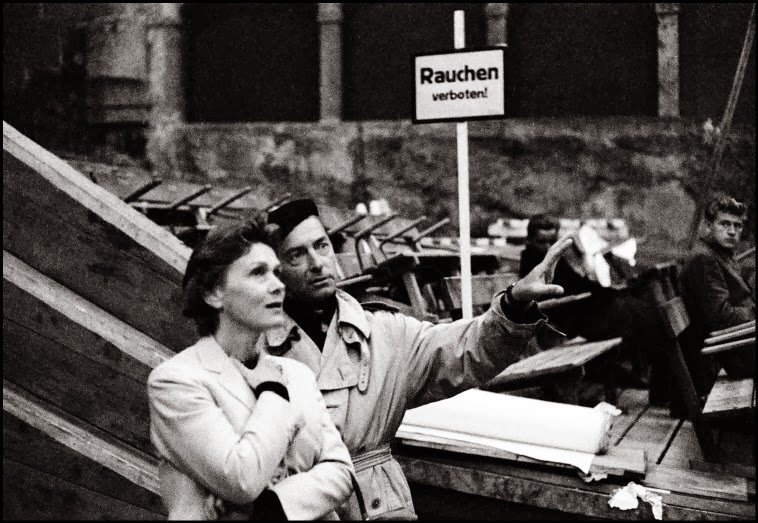
Salzburg 1957: Schwarzkopf And Karajan

Elisabeth Schwarzkopf and Herbert von Karajan in Salzburg in 1957, the year in which Karajan assumed the helm of the Salzburg Festival.

One of the new Salzburg Festival productions in 1957 was Verdi’s “Falstaff”, conducted by Karajan and with Schwarzkopf as Alice Ford.

However, I believe the photograph has nothing to do with that “Falstaff”. More likely the photograph depicts a visit to a rehearsal of Beethoven’s “Fidelio”, also given a new production in 1957 and staged in the Felsenreitschule (the photograph clearly was taken in the Felsenreitschule).

Tuesday, November 26, 2013

Disappointments

On Friday evening, my parents and Joshua and I went to Saint Paul to hear a Saint Paul Chamber Orchestra concert at the Ordway.

The guest soloist/guest conductor was Håkan Hardenberger, who was the attraction for us. Josh had played trumpet in grade school, junior high and high school, and he had wanted to hear Hardenberger.

Hardenberger played the Haydn Trumpet Concerto in the first half of the program. Hardenberger played to a reasonably high standard, but he is no longer in his prime—and Hardenberger has never been an interesting musician. It was a capable performance we heard, not a brilliant one.

In the second half of the program, Hardenberger played Heinz Karl Gruber’s 3 MOB Stücke, a “fusion” piece borrowing ideas from jazz and popular music. The work was composed in 1968 for seven interchangeable instruments and percussion, and revised in 1977. In 1999, at Hardenberger’s request, the composer created a version for trumpet and chamber orchestra. It was the 1999 version we heard.

I am not a Gruber admirer, and 3 MOB Stücke strikes me as a very weak piece, a European’s idea of “hot” music. I cannot understand what appeal Hardenberger finds in the score.

The concert began with Bach’s Orchestral Suite No 3 and ended with Haydn’s Symphony No. 103 (“Drumroll”). Hardenberger is not much of a conductor, and the performances were little more than run-throughs. The concert was, more or less, a waste of our time.

For us, it was the first SPCO concert of the season. We had contemplated an earlier SPCO concert in October—Stravinsky’s Dumbarton Oaks Concerto, Mozart’s Piano Concerto No. 23, Ives’s Three Places In New England and Schubert’s Symphony No. 5—but we had decided to take a pass, largely because we had heard that week’s guest soloist/guest conductor, Christian Zacharias, a few times too many the last few seasons.

There are only three SPCO concerts of interest to us the rest of the season.

The first, in January, will feature Hans Graf leading the orchestra in Shostakovich’s Symphony No. 14. If that week’s concerts were to be held at the Ordway, we most definitely would go—but that week’s concerts will be held in area churches, with their poor acoustics.

The second, in May, will feature Thomas Zehetmair leading a performance of Britten’s opera, “The Turn Of The Screw”.

The third, in June, will feature Roberto Abbado, the finest of the SPCO’s regular guest conductors, leading the orchestra in a program of Haydn, Barber and Schubert.

If Milwaukee were within reasonable driving distance of the Twin Cities, we would have skipped last weekend’s SPCO concerts and instead attended one of last weekend’s Milwaukee Symphony concerts, with Graf leading the Milwaukee orchestra in Mozart’s Symphony No. 39 and Schubert’s Mass No. 6. Graf is a splendid conductor of Mozart and Schubert, and I suspect that last weekend’s Milwaukee concerts, with the rarely-performed Schubert mass, were worth going out of one’s way to hear.

The SPCO needs to engage a Music Director. If an elder statesman is the objective, the SPCO could do worse than Graf, whose tenure in Houston concluded at the end of last season.

________________________________________________


Remember?
Remember?
The tenor on the boat that we chartered,
Belching “The Bartered Bride”.
Ah, how we laughed!
Ah, how we cried!

On Sunday afternoon, my parents and Josh and I went to Ted Mann Concert Hall to attend the final performance of the University Of Minnesota Opera Theatre’s production of Smetana’s “The Bartered Bride”.

Even for a student performance, the presentation was not at a high level. The production was rudimentary, the musical performance disappointing.

The opera was heavily cut, which turned out to be a blessing.

Friday, November 15, 2013

Minnesota Opera’s “Arabella”

For its presentation of Richard Strauss’s “Arabella”, Minnesota Opera had borrowed the 2012 Santa Fe Opera production.

The physical production—using a curvilinear unit set that swiveled—was cheap, unattractive and unstylish. Stage design and costume design were by Tobias Hoheisel.

The staging was provincial. The stage director, Tim Albery, demonstrated a pronounced fondness for broad, low comedy. His direction, fundamentally, was crude.

Albery did not possess a firm grasp of the material. The subtleties of Hugo von Hofmannsthal’s brilliant scenario flew thousands of miles over Albery’s head.

Regional Opera At Its Worst, Once Again

Walter Legge, writing at a time during which conventional wisdom believed that Richard Strauss went through a bad period between 1916, the year in which the final version of “Ariadne Auf Naxos” was premiered, and 1942, the year in which the wondrous “Capriccio” was unveiled, asserted that “Arabella”, from 1933, was a failure. “Arabella”, Legge argued, was nothing more than “a weak mixture of ‘Rosencavalier’ and water” and did not merit attention.

To this day, many persons share Legge’s assessment of “Arabella”—even those who have come to appreciate the beauties of Strauss’s other operas of the 1920s and 1930s. “Arabella” indeed does have much in common with “Der Rosencavalier”, particularly the class distinctions that are key elements in the plots of both works as well as the Viennese settings, firmly grounded in past (but vastly different) epochs.

Yet “Arabella” is, I believe, uniquely rewarding, featuring as it does a charming, operetta-like plot set to profound music—to which is added a fraught undertow of economic concern, the overwhelming issue of the years during which Hugo von Hofmannsthal wrote the libretto and Strauss the music. Is there any other opera that so vividly presents the waning financial fortunes of a family during perilous times?

I have always liked “Arabella”—in fact, I prefer it to “Der Rosencavalier”—and I believe my fondness has much to do with the opera’s title character, a most complex and winning young woman. Arabella is intelligent, well-bred, charming, spirited, emotionally generous—and irritating when she wants to be. She is loyal to her family, gracious to all (except when someone affronts her), prepared to deal with realities and make sacrifices—and yet she always maintains her essential dignity and inherent goodness (as well as a stiff backbone). Arabella is one of opera’s most enchanting characters.

“Arabella” needs only two things to come alive in performance: a great Arabella; and a decent Strauss orchestra.

Last night, Joshua and I went to Saint Paul to attend Minnesota Opera’s current production of “Arabella” (my parents and my sister-in-law had attended opening night).

There was no Strauss orchestra in the pit—there was a pickup ensemble that did not know how to approximate a lustrous Strauss sound. Minnesota Opera does not often present Strauss operas, and the contracted pit players were, stylistically, at sea. It was a rough—and loud—account of the glorious score we heard, blustery and insensitive, the sort of account to be encountered only in places that are music backwaters.

The conductor was Michael Christie, in his second year as Music Director of Minnesota Opera. I become less impressed with Christie with each encounter. He is a routinier—and a routinier without a first-class orchestra at his disposal. Who wants to hear a routinier leading a pickup group? In any event, Christie has no feel for Strauss; a Strauss conductor should have been engaged for the occasion.

The Arabella was a youngish American soprano whose career is centered in Germany. Two years ago she had been a musically bland, musically unsatisfying Fiordiligi in Minnesota Opera’s “Cosi Fan Tutte”. This season, her Arabella was less bland—the singer certainly tried to create a compelling musical characterization—but the final result was nothing more than a game try. At root, the singer does not have the glamorous voice for the part—and an Arabella without a glamorous voice is an Arabella no one wants to hear. (My father referred to her as “a hand-me-down version of Pamela Coburn”—and dedicated operagoers will know, instantly and precisely, what my father meant.)

The Mandryka was terrible. Simply put, the singer lacked the voice for major roles. He should have been replaced during the rehearsal period.

The performance belonged to the secondary couple, Zdenka and Matteo. (All operettas have a secondary couple; Hofmannsthal observed acutely every convention of the operetta stage while fashioning his “Arabella” scenario.) Elizabeth Futral, a superb actress with a less-than-superb voice, who had been the Musetta in last season’s Lyric Opera Of Chicago “La Boheme”, sang Zdenka. Brian Jagde, a young tenor in possession of the finest voice of the night (but not the finest artistry), sang Matteo.

The character parts, of which there are many in “Arabella”, were well-taken. I thought Arabella’s (and Zdenka’s) mother and father were particularly fine. (The Count Waldner had appeared in last season’s Chicago “Boheme”, too—as Benoit/Alcindoro.)

The physical production was from Santa Fe Opera, which had first presented this production in 2012. It was, above all, a budget-conscious production, with a semi-circular unit set that was neither attractive nor pleasing (but easy to ship; the production clearly had been designed with one overriding objective: to achieve lots of rentals). The costuming, too, was unattractive. The stage and costume design were of indeterminate period, and suggested at least six different decades, perhaps more, from the 1860s to the 1920s.

Since the plot of the opera and the plot’s conventions are firmly rooted in 1860, and reflect the uncertainties, economic and political, of the Austro-Hungarian Empire twelve years into the shaky early reign of Franz Josef (the opera is set one year after the disastrous Second Italian War Of Independence and six years before the even more disastrous Austro-Prussian War), for a production not to be tied to 1860 makes no sense.

The stage direction was busy—and shockingly unstylish. The director must have believed that large doses of hokum and vulgarity were necessary in order for the opera to come across to a contemporary American audience.

On that issue, the director was wrong. A well-presented “Arabella” will grip any audience anywhere.

Persons in Minnesota, however, did not get the chance to see that for themselves . . .

Whoever is making artistic decisions at Minnesota Opera is making disastrous choices over and over. Casting, selection of imported productions, engagement of stage directors: all reflect someone in possession of no judgment and no taste.

Wednesday, October 23, 2013

Partial To Russian Opera

My first “Eugene Onegin” at the Metropolitan Opera was on December 28, 1992.

Between Christmas Day and New Year’s Day that year, my parents had taken my brothers and me to New York, where we caught performances of “The Nutcracker” at New York City Ballet and “Eugene Onegin” at the Metropolitan Opera.

In advance of the “Eugene Onegin” performance, my parents had informed my brothers and me that we were free to declare, at the end of each act, whether we wanted to remain at the performance. My brothers and I had no trouble sitting through the entire opera.

The December 28, 1992, performance was the penultimate presentation of the 1957 Metropolitan Opera production of “Eugene Onegin”. The production was to be retired—at the conclusion of thirty-five years of service—after its final presentation three days later, on New Year’s Eve.

Rolf Gérard had been the designer for the 1957 “Eugene Onegin”. The original stage director had been Peter Brook.

At the 1992 performance we attended, we heard Ljuba Kazarnovskaya (Tatiana), Dwayne Croft (Onegin) and Jerry Hadley (Lensky). James Levine was conductor.

My grandparents had witnessed the same production in 1958, when the Metropolitan Opera’s annual tour had included a performance of “Eugene Onegin” in Minneapolis.

My parents and my grandmother attended the same production in 1980, when the Met once again toured “Eugene Onegin” to Minneapolis—and my parents caught the production a further time in 1985, when the Met brought “Eugene Onegin” to Minneapolis for the production’s final Twin Cities appearance.

________________________________________________


My second “Eugene Onegin” at the Met was on February 23, 2002.

We caught a performance that year during a family gathering in New York. I had flown in from Vienna, my older brother had flown in from London, my middle brother had flown in from Denver, and my parents had flown in from the Twin Cities. (At the time, it was easier for us to gather in New York for quick visits than anywhere else.)

2002 was our first encounter with the 1997 Robert Carsen production of “Eugene Onegin”.

At the 2002 performance, we heard Solveig Kringelborn (Tatiana), Thomas Hampson (Onegin) and Marcello Giordani (Lensky). Vladimir Jurowski was conductor.

________________________________________________


My third “Eugene Onegin” at the Met was on February 18, 2009.

That year, my parents and Joshua and I had met in New York over Presidents’ Day Weekend—my parents had flown in from the Twin Cities while Josh and I had driven down from Boston—and we had elected to hear “Eugene Onegin” at the Met that weekend rather than Puccini’s “La Rondine” (it was not an easy decision for us, as I recall).

We witnessed, once again, the Carsen production.

At the 2009 performance, we heard Karita Mattila (Tatiana), Thomas Hampson (Onegin) and Piotr Beczala (Lensky). Jiří Bělohlávek was conductor.

________________________________________________


“Eugene Onegin” is the only opera I have heard at the Met as many as four times.

The “Eugene Onegin” we attended ten days ago was the first Met performance Josh had attended in which Karita Mattila had NOT been the featured soprano (in succession, we had heard Mattila at the Met in “Jenufa”, “Salome”, “Manon Lescaut” and “Eugene Onegin”). Indeed, poor Josh had taken to calling the Met “The Karita Mattila Opera Company”.

We shall return to New York in February to attend the Met’s new production of Alexander Borodin’s “Prince Igor”.

Happily, we are all very partial to Russian opera.

Because there are no opportunities to hear Russian opera in the Twin Cities, we often make a point of catching Russian opera elsewhere whenever and wherever we may (such as Mussorgsky’s “Khovanshchina”, which we caught in January in Paris).

________________________________________________


Next month, we intend to catch Richard Strauss’s “Arabella” at Minnesota Opera and Bedřich Smetana’s “The Bartered Bride” at University Of Minnesota Opera Theatre.

However, we have been known, as performance dates approach, to scratch things off our calendars. Nonetheless, I very much doubt we shall skip “Arabella”: Strauss operas are not often staged in the Twin Cities (nor Smetana operas, for that matter).

Tuesday, October 22, 2013

Evoking Russia

The Guthrie Theater’s current production of Anton Chekhov’s “Uncle Vanya”, by and large disappointing, at least has a Russian look.

The Metropolitan Opera’s current production of Peter Ilyich Tchaikovsky’s “Eugene Onegin”, also disappointing, evokes Russia not at all. The production has a peculiarly British look, entirely inapt for Alexander Pushkin’s tale.

The Met “Eugene Onegin” is so British through and through, it might as well be set in Chipping Cleghorn.

Gergiev Times Two: Evening Two—Tchaikovsky

The Saturday evening before last, we heard Tchaikovsky’s “Eugene Onegin” at the Metropolitan Opera. The conductor was Valery Gergiev.

Gergiev is now sixty years old. He has been conducting “Eugene Onegin”—all over the world—for almost four decades, and I question whether he still responds to the score. There was no affection in his reading, no sense of a propriety interest in the music. He offered a tired account of “Eugene Onegin”; the conducting lacked energy, concentration, focus—and polish.

Gergiev did not even rise to the big moments. Tatiana’s letter scene is as much a showcase for conductor as for soprano, yet Gergiev’s handling of the letter scene fell flat. The frenzied activity at the end of Act II, Scene I, lacked adrenaline (Georg Solti blew the roof off in this scene). There was no drama from the pit even during Tatiana’s and Onegin’s final parting in Act III.

“Eugene Onegin” is, above all, a conversational opera. The big moments are glorious and must make their effects, yet a performance cannot work unless the conductor understands how to shape the intimate conversations that constitute the heart of the drama. Musical tension must be sustained, yet the conversations must come across as natural and unaffected; the orchestra must offer ear-beguiling sounds, yet at the same time the conductor must acutely and dispassionately provide structure and continuous momentum. Gergiev met none of the requirements.

The big moments aside, Gergiev’s tempi were slow. The immediate effect was to lend a heavy quality to everything, including the rustic Act I, Scene I, which should be anything but heavy. Gergiev speeded up for the big moments, as if someone had slipped him an injection, but afterward he quickly returned to turgidly-slow tempi. Gergiev single-handedly killed the performance, what with the ponderousness he administered.

Gergiev is very free with tempi in music of Tchaikovsky. A too-free approach to tempi in Tchaikovsky drains the music of discipline and reserve—and discipline and reserve are key components of everything Tchaikovsky wrote, despite the composer allowing an occasional release of hysteria.

Gergiev takes a minute-by-minute approach to conducting; he is always in search of the next highlight. Anyone who has heard Gergiev’s near-laughable Tchaikovsky recordings with the Vienna Philharmonic (a great and noble Tchaikovsky orchestra) is already familiar with how Gergiev shamelessly stretches and pulls about Tchaikovsky’s music, to vulgar and brutal effect.

Gergiev was the fourth conductor I have heard lead “Eugene Onegin” at the Metropolitan Opera. The previous three conductors, in order, had been James Levine, Vladimir Jurowski and Jiří Bělohlávek. Of that group, only Jurowski had been a capable—although far from perfect—conductor of the score.

The Met needs to engage Gennadi Rozhdestvensky or Yuri Temirkanov or Daniele Gatti for future revivals of “Eugene Onegin”. All are exceptional Tchaikovsky conductors.

________________________________________________


Anna Netrebko sang Tatiana. Netrebko’s voice is enormous; it has richness and color in abundance. It was a pleasure merely to sit back and listen to wave after wave of glorious sound. Otherwise, Netrebko’s Tatiana was oddly unaffecting—Netrebko did absolutely nothing with the part—and she appeared to have received no guidance from the stage director. (Netrebko was poorly costumed, which did not help matters.)

Onegin was Mariusz Kwiecien. Kwiecien’s voice is much smaller—and much drier—than Netrebko’s, which made it difficult for him to compete against his heroine. Kwiecien’s physical portrayal of Onegin, however, was very fine—and on occasion moving (Kwiecien presents a very likeable figure onstage). Kwiecien was the only singer among the principals with acting skills—and the only one with significant stage presence.

Piotr Beczala sang Lensky. Beczala had appeared as Lensky the last time I attended “Eugene Onegin” at the Met, and I found Beczala no more remarkable this go-around than last go-around. My ears do not find Beczala’s voice or artistry unique; he is a capable singer, nothing more. (Beczala, a wooden actor, is now too old for Lensky; Beczala looked like Kwiecien’s father, not Kwiecien’s peer—and Kwiecien himself is no spring chicken.)

I very much liked three members of the supporting cast, all complete artists: Oksana Volkova (Olga); Elena Zaremba (Madame Larina); and Larissa Diadkova (the nurse).

Everyone else onstage possessed talents more suited to Minnesota Opera than the Metropolitan Opera.

________________________________________________


The physical production had premiered in 2011 at English National Opera, although Act I—at the Met’s insistence—had been significantly revised for the New York presentation.

The production was too small in scale for the Met; it probably would have been more successful in a smaller theater. (My father’s pithy dismissal: “This production might have been a big hit in Madison.”)

The action was advanced to the late 19th Century for no ostensible reason. The stage design and costume design were more British than Russian (many of the costumes looked like leftovers from an old “Peter Grimes” production).

All of Act I—including the letter scene—was played in what appeared to be a conservatory converted into a fruit market. Act III, Scene II, was played out-of-doors, in a snowstorm.

The direction was provincial, and included odd, gratuitous bits of staging, such as kisses exchanged between Tatiana and Onegin in Acts I and III. The peasant choruses and dances in Act I were turned into Russian Orthodox ceremonials, complete with religious icons. Tatiana, in Act III, was dressed like Dowager Empress Maria Feodorovna.

Such a witless production should be sent back across the water promptly and not allowed to return to these shores.

________________________________________________


The performance was sold out; all tickets were taken weeks before performance night.

We had obtained our tickets back in August. Had we delayed, we very well might have been left out.

The audience response to the performance was restrained, especially so given that Gergiev, Netrebko, Kwiecien and Beczala are all big names.

Tuesday, October 15, 2013

“Eugene Onegin” At The Met

The aftermath of the duel in Tchaikovsky’s “Eugene Onegin” at the Metropolitan Opera.

The production appeared to be a handsome one in published photographs. In person, the production was nowhere near as beautiful as the photographs had suggested and, further, the production—borrowed from English National Opera—was wrongly-scaled for the vast stage and vast auditorium of the Met.

What we encountered was a provincial production, given a provincial staging, precisely the sort of thing one sees at the Coliseum, home of ENO.

We were disappointed, and wondered whether we should have caught the matinee performance of Shostakovich’s “The Nose” instead.

Monday, September 30, 2013

Minnesota Opera’s “Manon Lescaut”

Alas, Kelly Kaduce’s Manon carried more than a whiff of the middle-aged hausfrau from Bremen. Had Kaduce possessed a deeper understanding of Puccini’s idiom and the Italian style, her other shortcomings would not have mattered so much.

The man dancing at Kaduce’s side bore an alarming resemblance to Osmo Vänskä, needing only a bottle of vodka to complete the successful red-faced impersonation.

Regional Opera At Its Worst

On Thursday evening, Joshua and I took Josh’s sister to Saint Paul to attend a Minnesota Opera performance of Puccini’s “Manon Lescaut”.

The performance was disappointing.

Michael Christie’s conducting lacked the drive and sweep Puccini’s score requires, and the orchestra was too small—sixty players—to produce the radiance of sound that is an essential part of Puccini’s sound world. Minnesota Opera uses what is, in effect, a pickup orchestra, and on Thursday evening the sounds emanating from the pit were those of a pickup ensemble. No one who has heard Puccini’s earliest masterpiece played by a real orchestra would have found the work of the instrumentalists used by Minnesota Opera anything other than proficient.

“Manon Lescaut” was the fourth opera I have heard Christie conduct at Minnesota Opera, and I have become less impressed each time I have encountered his work. Christie is, I fear, a modern-day Cal Stewart Kellogg: a conductor whose skill level will always confine him to engagements with regional enterprises.

Minnesota’s home-grown diva, the locally-ubiquitous Kelly Kaduce, sang Manon. Kaduce is an effective stage animal, but she lacks a first-class instrument (as well as the heft the role of Manon requires). If watching a silent film, I would have found Kaduce’s portrayal of Manon worthy of some respect. Hearing Kaduce’s Manon was another matter—it was a reaffirmation of the reason why Kaduce, with a career almost two decades old, has never been touched by a major house: her voice is insufficiently fine for a major theater to offer her even the tiny role of the madrigal singer in the same opera.

The other cast members were even less impressive than Kaduce. The des Grieux surely needed five more years of study before being unloosed on the world, and the remainder of the cast list displayed a level of artistry to be encountered at minor music conservatories. I cannot recall the last time I attended a Minnesota Opera presentation in which the casting had been so poor; Minnesota Opera’s “Manon Lescaut” was regional opera at its worst.

The physical production had been rented from Washington Opera, and I had seen the production at its unveiling in Washington in 2004. Although fairly elaborate, the production is not a handsome one—the colors are garish, and the designs are a hackneyed blend of realism and surrealism. Given the unattractive color scheme, the costumes are quite good.

During much of the performance, texts from the Prévost novel—in English translation—were projected onto the back of the stage. I presume this was intended to give the audience something to read once the program booklet had been devoured, surely a conciliatory gesture, when one considers how uninteresting were the onstage proceedings.

Sunday, September 29, 2013

Puccini’s Post-“Manon Lescaut” Postcard


Until World War II, it was common practice for Europe’s artists—authors, composers, singers, actors, dancers—to keep a stock of postcards on hand to send to well-wishers.

Puccini never enjoyed a success until “Manon Lescaut”, but “Manon Lescaut” proved such an instant sensation that Puccini became an overnight celebrity in Europe—and had the above postcard created, a postcard he continued to send to well-wishers until at least 1911. (There were other postcards Puccini was to commission, including the well-known 1895 full-length photographic portrait as well as the famous cameo portrait and the famous overcoat portrait, both of which post-date “Tosca”.)

“Manon Lescaut” premiered in Turin in 1893. Exactly one week later, Verdi’s “Falstaff” premiered in Milan.

The changing of the guard had occurred . . . although no one was to realize it for some years to come.

Thursday, September 26, 2013

Tonight At 7:30

Giacomo Puccini’s “Manon Lescaut” at Minnesota Opera.

Minnesota Opera has rented the 2004 Washington Opera production of “Manon Lescaut”. I saw that production when I was in law school, during the production’s initial run of performances, and it is not a good one.

Nonetheless, I have always been fond of “Manon Lescaut”, and I shall be happy to hear the opera again tonight.

We last heard “Manon Lescaut” in February 2008, when we attended a performance at the Metropolitan Opera.

Tuesday, September 24, 2013

Plans

Other than a football game (Minnesota’s season-opening win over U.N.L.V.), Joshua and I have seen and done nothing since returning from Canada more than six weeks ago.

We skipped Bloomington Civic Theatre’s presentation of “Singin’ In The Rain”, a production now closed. I have never seen any of the stage adaptations of the musical film, and I doubt I have missed much; the very notion of turning one of Hollywood’s greatest musicals into a stage vehicle strikes me as wrong-headed. In any case, we were told that the B.C.T. “Singin’ In The Rain” was not good.

We intend to skip Jungle Theater’s current production of “Fool For Love” because we are not in the mood for a Sam Shepard play. A couple of years ago, Josh and I saw an exceptional production of Shepard’s “True West” at Minneapolis Theatre Garage, but we are not keen on more Shepard at present. I have to be in the proper frame of mind to tolerate Shepard’s fundamentally ugly view of mankind, and at the moment I am not in that frame of mind.

Everything else on our list has been saved for this coming weekend, when Josh’s sister will come for a visit.

Despite the fact that Josh’s sister has no interest in sports, we plan to take her to the Minnesota/Iowa game. For us, this is the most important game of the year—we seldom miss the Minnesota/Iowa game—and we hope she will find some enjoyment at the stadium. Saturday will be Homecoming, and extra festivities will be on offer in addition to the standard game-day attractions.

We have tickets for Puccini’s “Manon Lescaut” at Minnesota Opera, and we are confident that Josh’s sister will enjoy the Puccini.

We also have tickets for Chekhov’s “Uncle Vanya” at The Guthrie Theater, and we have tickets for David Auburn’s “Proof” at Bloomington Civic Theatre.

Further, we have tickets for Molière’s “The Imaginary Invalid” at Theatre In The Round, but we shall not use them. We had looked forward immensely to the Molière, but our former landlady warned us off the production, telling us that Theatre In The Round’s “The Imaginary Invalid” was the worst thing to hit the Upper Midwest in decades.

Instead, at our former landlady’s insistence, we shall see a production that had not even been on our list: David Lindsay-Abaire’s “Good People” at Park Square Theatre. Our former landlady says that “Good People” is the finest production in town, and must not be missed—and we have decided to heed our former landlady’s advice.

Consequently, between Thursday evening and Sunday afternoon, we shall be dragging Josh’s sister to three plays, one opera and one football game.

However, only one of the plays, and not two, will be a classic—a slight change from our original plans.

Saturday, August 17, 2013

Hans Knappertsbusch At The 1941 Salzburg Festival


Conductor Hans Knappertsbusch in conversation with Hermann Wiedemann during a rehearsal of Richard Strauss’s “Der Rosencavalier” (Wiedemann was to sing the role of Faninal) at the 1941 Salzburg Festival.

The official history of the Salzburg Festival portrays the 1941 season as a grim one:

Audiences consisted mainly of soldiers, whether on leave or recovering from wounds, and workers from German and Italian munitions factories. The Festival functioned as a sort of psychological weapon of domestic warfare and manipulation: as catastrophe loomed ever larger on the horizon, the people’s morale had to be shored up and their worries dispelled.

The official history’s characterization of the period is wrong. It is worse than inaccurate, worse than revisionist, worse than foolish—it is completely fictive.

In August 1941, German forces were proceeding from triumph to triumph in North Africa and throughout Russia. Germany’s advances seemed unstoppable; the high-water mark of German conquest had yet to be achieved. The mood of the populace of the Reich was euphoric. Only in December 1941, with America’s entry into the war and the onset of winter weather halting advances on The Eastern Front, did the public mood in the Reich become restrained.

The 1941 Salzburg Festival in no way reflected wartime conditions or wartime austerity. The Festival that year introduced two new Mozart productions, both conducted by Karl Böhm, to mark the 150th anniversary of the composer’s death: “Le nozze di Figaro” and “Die Zauberflöte”. They were joined by a revival of another Mozart opera, “Don Giovanni”.

A sign that war privations were far, far into the future: the Salzburg Festival was to introduce yet another new production of “Le nozze di Figaro” (directed by Walter Felsenstein) in 1942, the second such new production in two seasons; and the Salzburg Festival was to introduce yet another new production of “Die Zauberflöte” in 1943, the second such new production in three seasons. Lavish expenditures for new productions of the same works, in close succession, do not bespeak a nation yet imperiled by—or even aware of—looming catastrophe.

Monday, August 12, 2013

Krauss, Orff, Hartmann And Kugler

Clemens Krauss, Carl Orff, Rudolf Hartmann and Josef Kugler in Munich in 1939, while the premiere of Orff’s opera, “Der Mond”, was in preparation.

Krauss and Orff are known to all.

Hartmann was Chief Of Productions at the Bavarian State Opera from 1938 to 1944, overlapping the period in which Krauss was Chief Conductor at the theater. Hartmann returned to lead the company as Intendant from 1953 to 1967. After retiring from the theater, Hartmann authored a well-respected book on the staging of Richard Strauss operas; more than thirty years after its initial publication, the book remains in print—and is essential reading for opera aficionados. In 2003, my brother and I attended, purely by chance, a splendid exhibition devoted to Hartmann in one of Munich’s many museums. The exhibition occurred fifteen years after Hartmann’s death, fifty years after Hartmann first took the helm of the Bavarian State Opera, and sixty-five years after Hartmann first became associated with the company. Hartmann was a learned, accomplished, fascinating man. Persons of his quality no longer lead theaters, within Germany or elsewhere.

In 1939, Kugler was Chorus Master at the Bavarian State Opera. Kugler continued in the post for many years—he was still Chorus Master when Eugen Jochum made his celebrated Orff recordings in Munich in the 1950s.

Friday, June 21, 2013

Comings And Goings

We skipped Bloomington Civic Theatre’s recent production, now closed, of Yasmina Reza’s oft-performed “Art”. We simply were unable to interest ourselves in a non-professional production of such a schematic play.

Minneapolis Musical Theatre’s current production of Andrew Lloyd Webber’s musical, “Sunset Boulevard”, closes this weekend at New Century Theatre. The reviews scared us off—and word-of-mouth has been even worse than the reviews. I am told ticket sales have been very scarce.

We are presently trying to decide whether Park Square Theatre’s current production of Jeffrey Hatcher’s “Sherlock Holmes And The Adventure Of The Suicide Club” is worth a trip to Saint Paul. We are also trying to determine whether Theatre In The Round’s current production of Ludmilla Bollow’s “In The Rest Room At Rosenblooms”, a play whose premise sounded promising on paper, can possibly be as bad as the reviews have suggested.

This weekend, we WILL see The National Theatre Of Great Britain’s production of “War Horse”, a stage adaptation of the Michael Morpurgo children’s novel. “War Horse” has settled in for a two-week run at the Orpheum Theatre.

________________________________________________


In August, for the first time, we shall attend The Stratford Shakespeare Festival.

Over four days, we shall see eight of this year’s twelve Stratford productions.

Each day, we shall pair a heavy play with a not-so-heavy play.

On our first day, we shall see “Blithe Spirit” and “Measure For Measure”. On our second day, we shall see a new work and Schiller’s grand “Mary Stuart”. On our third day, we shall see “The Merchant Of Venice” and “Fiddler On The Roof”. On our final day, we shall see “Romeo And Juliet” and a new stage adaptation of “The Three Musketeers”.

The 2013 Stratford Shakespeare Festival should be a good follow-up to last summer’s visit to The Shaw Festival, where we saw everything on the bill.

________________________________________________


As a general rule, we do not attend concerts or other music events in summer months—and this summer will be no different. There is nothing announced we want to hear.

The Twin Cities hosts a couple of minor enterprises, both small, that offer summer opera performances; we have never paid attention to either enterprise. Skylark Opera offered “The Mikado” this summer. I believe the performance run has already ended. Mill City Opera will offer “The Barber Of Seville” next month. We shall not be in attendance.

Each July, the city of Winona convenes its Minnesota Beethoven Festival. We have never attended a single performance—although we had acquired tickets last year to hear the Leipzig Quartet (at the last minute, we decided to go up to the lake that weekend rather than down to Winona).

The rarest of occurrences is scheduled for this year’s Minnesota Beethoven Festival: an appearance by a visiting orchestra. The Russian National Orchestra is scheduled to give one concert (under a conductor unknown outside Russia) during the Minnesota Beethoven Festival. The orchestra’s Winona appearance will be the first by a visiting orchestra to Minnesota in years and years and years; visiting orchestras are never heard here.

We shall not attend the concert. We have no desire to drive all the way down to Winona and back on a weeknight.

________________________________________________


In decades past, my parents used to be able to drive down to Ames or Iowa City on an occasional weekend and hear top-flight American and European orchestras on tour. Both Iowa State University and The University Of Iowa used to sponsor appearances by world-class artists and ensembles in extensive (and very impressive) performing-arts subscriptions.

Performing-arts subscriptions, everywhere, began to wither in the 1990s; for reasons of mounting cost, it became impossible for universities—or other sponsors—to continue such programming at exalted levels.

Today, if one wants to hear touring orchestras with any frequency, one must travel to New York or Washington—or to Europe.

Thursday, May 23, 2013

We Should Have Been At The Kimbell

On Sunday afternoon, Joshua and I heard the Dallas Symphony in a program devoted to music of Wagner. The conductor was the orchestra’s Music Director, Jaap van Zweden.

Act I of “Die Walküre" was the primary work on the program.

Zweden was lost in “Die Walküre". Wagnerian melos was not to be heard under Zweden’s baton. The conductor had no grasp of the drama depicted in one of Wagner’s greatest spans of music; the conductor was unable to unleash the emotions that surge through Wagner’s score.

The ebb and flow Wagner built into his music, a never-ending cycle of tension and release, had been ironed out by Zweden. Everything was too swift, everything was too light, everything was too objective, everything was too uninflected, everything was too vaporous. Zweden might as well have been conducting a “number” opera, given his inability to build a head of steam and command a long time span.

I wondered whether Zweden’s swift tempi constituted a concession to an inadequate cast of singers.

The Siegmund was Clifton Forbis, possessor of a dry, grainy voice that sounded years past its prime. (It is my understanding that Forbis is in the process of giving up the stage.)

The Sieglinde was Heidi Melton, who did not for one second capture Sieglinde’s radiance. Melton has no individuality at all: Melton’s voice lacks distinctive qualities, Melton’s artistry is all-purpose. Wagnerians would be unable to pick out Melton’s Sieglinde from a police audio lineup.

The Hundig was Eric Owens. Owens had the only first-class voice onstage. Owens’s voice is incredibly rich, with amazing depth and resonance, and it is a voice of great beauty and of unique timbre. Owens is destined to achieve stardom.

Owens is not a Wagner singer. Owens’s voice is an “open”, “American” voice, with an open, American sound, ideal for American music—and no other. Owens was at sea in trying to shape Wagner’s phrases—and his German seemed to have been picked up in Appalachia.

Owens had been scheduled to sing Adams’s “The Wound Dresser” with the Saint Paul Chamber Orchestra this season. It was an appearance Josh and I had looked forward to. We hope the SPCO will reschedule “The Wound Dresser” with Owens in the next season or two.

Three Wagner orchestral works were played prior to Act I of “Die Walküre”.

The concert began with the Prelude to “Lohengrin”.

Zweden chose a very quick tempo, but—fatally—he could not find a pulse, and the players were unable to help Zweden find a pulse. The result was a disastrous performance, false entries everywhere, uncomfortable looks on faces all over the stage. Balancing was an issue: the brass was too prominent, the strings under-nourished and colorless and faceless.

I was dumbfounded. The “Lohengrin” Prelude is nothing more than an extended crescendo-decrescendo. Any conductor should be able to lead the work capably—and yet Zweden had offered a performance that would have been unacceptable in a provincial outpost.

The Prelude to Act III of “Lohengrin” followed. Zweden played it as orchestral showpiece, in the manner of Arthur Fiedler.

Next came the Prelude to “Die Meistersinger”. Zweden’s tempi were too fast, and he did not catch the work’s exultation and grandeur—or even the necessary dignity and nobility.

The counterpoint of “Meistersinger” neither registered nor “spoke” as it must—“Meistersinger” is nothing but a glorious display of counterpoint writing—and balancing issues clearly were the root cause of the counterpoint deficiencies. Instrumental lines that should have been heard were inaudible, subsidiary lines that should have remained subsidiary often became overpowering. Counterpoint not telling in Zweden’s hands, the “Meistersinger” Prelude came across much like a French potpourri overture by Hérold—the very thing that would have appalled the composer of “Meistersinger”.

I last heard the Dallas Symphony in February 2008. The orchestra was in much better shape in 2008 than it is today.

On Sunday, balancing was off all afternoon. I did not hear a proper balance once.

The string section was unable to produce the glow Wagner’s music demands. It has been a long time since I heard such featureless, bland, anemic string playing.

The winds did not register as they must, weaving in and out of the musical line, taking charge one moment, disappearing into the orchestral fabric the next.

The brass playing was very disappointing. The section did not produce a uniform, integrated sound.

All afternoon, the musicians played as if they were bored by the music, and unconvinced by Zweden’s interpretations.

Perhaps the Dallas musicians were suffering from exhaustion at the end of a long concert season that had included a grueling tour of Europe.

Perhaps substitute musicians contributed to the haphazard nature of the orchestra’s work. Numerous substitute musicians were on the Dallas concert platform on Sunday, including two brass principals (trumpet, horn) that are members of orchestras elsewhere (Chicago, Baltimore).

Whatever the causes of the shortcomings, what we heard on Sunday was basically unforgivable, coming as it did from what is supposed to be a major ensemble.

If Sunday’s Wagner concert is representative of Zweden’s work in Dallas, the Dallas Symphony has a major problem on its hands.

Josh and I should have devoted Sunday afternoon to the Kimbell Art Museum in Fort Worth.

Monday, April 29, 2013

Along Suffolk Lanes


[Benjamin Britten] adored the company of boys. As John Bridcut revealed in his groundbreaking “Britten’s Children” in 2006, the composer had intense crushes on a string of 13-year-olds, during which the recipients were invited to Aldeburgh and treated like Greek gods. The pattern was always the same. Britten would dazzle each with his charisma, write letters couched in what now seems like creepy, infatuated language, ply them with treats, swim and play tennis with them, whizz them along Suffolk lanes in his sports car, hug them—and sometimes (as with the screen actor David Hemmings, who as a boy had been the original Miles in “The Turn of the Screw”) share a bed.

There is, one should say, no evidence that he went farther. “Am I a lecher just because I enjoy the company of children?” he once spat at the conductor Sir Charles Mackerras, who had quipped that Britten’s “Noye’s Fludde”, with its big children’s chorus, was “Ben’s paradise”.

But then, soon after they reached puberty, the boys were inevitably discarded in favour of next year’s model, often with peremptory callousness (Britten had a notoriously fickle attitude to people who were no longer useful).

Richard Morrison, writing in The Times on 19 January 2013

________________________________________________


We did not have the stomachs to sit through two recent presentations of Britten operas in the Twin Cities.

The weekend before last, University Of Minnesota Opera Theatre presented four performances of Britten’s “A Midsummer Night’s Dream”. I dislike the work intensely—the music is weak-as-water—and it would have been a chore for us to endure one of the performances. In any event, the University Of Minnesota has a dismayingly mediocre Music Department—not the case half a century ago—and has not been able to attract a satisfactory level of faculty talent or student talent for twenty or thirty years.

The weekend just ended featured two performances of Britten’s “Paul Bunyan” by VocalEssence, a local organization that—in its former incarnation, Plymouth Music Series—made a famous recording of “Paul Bunyan” more than twenty years ago. Opportunities to hear “Paul Bunyan” are exceedingly rare, but we did not avail ourselves of the chance.

I more or less share the thoughts of Igor Stravinsky, Herbert Von Karajan and Pierre Boulez when it comes to the music of Britten: the music is so second-rate, why does anyone bother?