Sunday, May 15, 2011

Budapest Opera House


The interior of the Budapest Opera House in 1947. Otto Klemperer was Music Director of the Budapest Opera at the time.

Friday, May 13, 2011

Wherein Some Daring Dances Figured


CELL FOR TRADUCER OF FRIEDA HEMPEL


________________________________________________


Berlin Court Condemns Editor Of Kleine Journal To A Month In Prison

________________________________________________


ASSAILED HER CHARACTER

________________________________________________


Insinuated King Leopold Decorated Prima Donna After She Had Participated In “Bacchanalian Feast”

________________________________________________


Special Cable To The New York Times

Berlin, November 15—Fraulein Frieda Hempel of the Metropolitan Opera House, New York, won today her suit for criminal libel against the editor of Kleine Journal, a sensational weekly, which insinuated that her decoration of the Leopold Order was conferred upon her by the late King Of The Belgians following her participation in an orgy at Leopold’s Summer Palace at Ostend.

The offending editor was sentenced to imprisonment for one month.

Fraulein Hempel filed suit against the proprietor of the offending newspaper in December 1912, just before sailing to America to appear at the Metropolitan Opera House. The incident narrated in the paper was alleged to have occurred at the Ostend Villa of the Baroness Vaughan, the morganatic wife of the late King Leopold.

Fraulein Hempel’s testimony was given by deposition, as she was not able to appear personally on account of her engagements to sing in America. She denied that after the King had departed from the soiree ”champagne corks popped like shots from a rapid-fire gun” and that the affair became “a Bacchanalian feast” wherein some daring dances figured. She said that she went to the Villa to sing just as if it had been a regular professional engagement and that she went home as soon as the concert was over.

The publication of the insinuations about her, she maintained in her complaint, would tend to injure her in the eyes of Americans.

________________________________________________


Published November 16, 1913
The New York Times

Sunday, May 08, 2011

"A Concert In The Year 1846"


Graphics artist Andreas Geiger’s famed “satirical picture” of Hector Berlioz, “A Concert In The Year 1846”.

Dutoit In Berlioz

Last night, Joshua and I went to Symphony Hall to hear Charles Dutoit lead the Boston Symphony in Berlioz’s “Romeo And Juliet”.

The Boston Symphony has a distinguished history performing “Romeo And Juliet”. Both Charles Munch and Seiji Ozawa recorded the work, famously, during their respective tenures as Music Director of the Boston Symphony.

The Boston Symphony’s former special expertise in French music is now a thing of the past. The orchestra no longer has anything special to offer in French repertory. The orchestra’s thick, flabby sound, the chief legacy of the disastrous James Levine years, is much too “Germanic” to reveal the color and piquancy of French music. Further, the orchestra no longer has the flair needed to bring French music to life—the orchestra’s collective sense of rhythm is too square and plodding, its phrasing too blunt if not brutal, the elegant and patrician style of music-making from fifty years ago replaced by an unattractive and disheartening brusqueness and beefiness. This is an orchestra in dire need of a competent Music Director.

Dutoit is a fine if not particularly memorable conductor of Berlioz—yet he is the finest Berlioz conductor that may be heard on a regular basis today in the United States.

Dutoit’s Berlioz, in my experience, tends toward the light and fleet—Dutoit’s Berlioz certainly lacks the color, depth and drama of Colin Davis’s Berlioz—and I often find a “bleached” quality in Dutoit’s Berlioz performances. Nonetheless, Dutoit’s Berlioz is undeniably French in outlook; no one would mistake Dutoit’s Berlioz interpretations as emanating from Central Europe.

Last night, I thought that Dutoit viewed his chief mission as one of keeping things moving. Had Dutoit had the Philadelphia Orchestra at his disposal, I suspect Dutoit would have sought more color and drama from the musicians—and allowed first-desk personnel to participate actively in lending shape and character to the performance. However, given what he had to work with, Dutoit kept a tight rein on the proceedings. There was very much a “traffic cop” aspect to his leadership—and Dutoit cannot be faulted for such an approach, since Dutoit knows as well as anyone alive how to gauge what results may be obtained from a particular band of musicians and what results may not.

Two years ago, Josh and I had heard Dutoit lead the Boston Symphony in music of Ravel, Prokofiev and Stravinsky. That night had been a very happy one for us—and, from his smiles, it had been a happy night for Dutoit, too.

There were fewer smiles from Dutoit last night. Dutoit’s tense if not grim facial expression suggested that he simply wanted to get through the score without suffering a major incident.

The best thing about last night’s performance was mezzo-soprano Bernarda Fink. Fink possesses a glorious voice. She has been blessed with a unique timbre, she has been granted a voice of extraordinary color and richness, she knows how to phrase with great specificity, and she knows how to project a text. Fink is one of the finest singers currently before the public. I would drive 200 miles in an instant to hear her in recital.

The other soloists were Jean-Paul Fouchecourt and Laurent Naouri, neither of whom is in possession of a unique timbre and both of whom command voices of pronounced dryness.

The chorus was the Tanglewood Festival Chorus, which performed to its usual low standard. Why is choral singing in Boston so atrocious? Is it something in the water supply?

Josh and I learned last night that this week’s performances of “Romeo And Juliet” were the very first performances of the work by the Boston Symphony that did not include an intermission. We were astonished when this very odd fact was brought to our attention. I cannot conceive of a more wrong-headed notion than inserting an intermission into “Romeo And Juliet”. The very idea is as laughable as inserting intermissions into performances of Brahms’s Requiem.

Contrary to reports in at least one Boston news outlet, Dutoit was not filling in this week for an indisposed Levine. Dutoit had always been scheduled to lead this week’s “Romeo And Juliet” performances.

Last night marked the end of the Boston Symphony’s 2010-2011 subscription series. It also marked the final time Josh and I will hear the Boston Symphony as residents of Boston.

The next time we hear the orchestra, I hope it will be with Riccardo Chailly at the helm, with a couple of years of reparative work already under the belts of orchestra and conductor.

Friday, May 06, 2011

"The Worst Conceivable Omen For The Next Twelve Years"

This evening's Mosquito raid was particularly disastrous for me because our Ministry was hit.

The whole lovely building on the Wilhelmstrasse was totally destroyed by a bomb. The throne-room, the Blue Gallery and my newly rebuilt theater hall are nothing but a heap of ruins.

I drove straight to the Ministry to see the devastation for myself. One's heart aches to see so unique a product of the architect's art, such as this building was, totally flattened in a second. What trouble we had taken to reconstruct the theater hall, the throne-room and the Blue Gallery in the old style! With what care had we chosen every fresco on the walls and every piece of furniture!

And now it has all been given over to destruction.

In addition, fire has now broken out in the ruins, bringing with it an even greater risk, since 500 bazooka missiles are stored underneath the burning wreckage. I do my utmost to get the fire brigade to the scene as quickly and in as great strength as possible, so as at least to prevent the bazooka missiles exploding.

As I do all this I am overcome with sadness. It is 12 years to the day—13 March—since I entered this Ministry as Minister. It is the worst conceivable omen for the next twelve years.

Joseph Goebbels, Germany’s Minister Of Public Enlightenment And Propaganda, writing in his diary on 13 March 1945

________________________________________________


There were not to be another twelve years, either for Goebbels or for the Ministry. There were to be only another 49 days.

________________________________________________


The bombing of the Ministry Of Public Enlightenment And Propaganda occurred on the night of March 12/March 13, 1945. When Goebbels, in his diary entry of March 13, wrote of “this evening’s Mosquito raid”, he was actually referring to the raid of the previous night.

The photograph below shows the bombed Ministry building on 13 March 1945, the day after the overnight bombing raid.


As may be seen in the photograph, much of the bomb damage had already been cleared from Berlin’s streets. Even in the very last days of the war, workers throughout Germany cleared city streets of rubble within hours of air raids; such efficiency was remarkable.

Goebbels’s Ministry occupied two buildings. The original Ministry building, Leopold Palace (also known as Ordenspalais), was the building destroyed on the night of March 12/March 13.

Leopold Palace had been purchased by the German government in 1919 to serve as a government press building. Leopold Palace previously had served as home to various princes of the Hohenzollern crown; with the collapse of the Hohenzollern dynasty in November 1918, the German government decided to make use of the structure, and turned it into a government building. This accounts for Goebbels’s unlikely references to a throne room, a blue gallery and a theater in his Ministry building—all were remnants of the building’s royal past.

A modern annex for the Ministry was constructed during the 1930s and was repeatedly enlarged, even during wartime; the modern annex only reached its final form under Goebbels in 1942 (and was to be enlarged yet again after the war by East Berlin authorities). The modern annex suffered damage during the same air raid that destroyed Leopold Palace, but the modern annex was neither destroyed nor burned out. The modern annex still stands, and remains in use; it today houses one of Germany’s many federal agencies.

Whenever persons encounter, in books or online, photographs of Goebbels’s Ministry, the photographs invariably depict the 1930s annex and not Leopold Palace.

The ruins of Leopold Palace were dynamited and bulldozed by the East German government in 1947. Nothing of Leopold Palace remains in present-day Berlin.

The photograph below shows one of the grand public rooms of Leopold Palace in 1926.


As Goebbels mentioned in his diary, his Ministry had restored Leopold Palace to a lavish standard while Goebbels was Minister. The photograph below, from 1940, shows the theater of Leopold Palace after the Nazi-era restoration.


Goebbels conducted press briefings and other public events in the theater.

It was a very handsome space, featuring design of the highest standard.

Thursday, May 05, 2011

Aid And Assistance


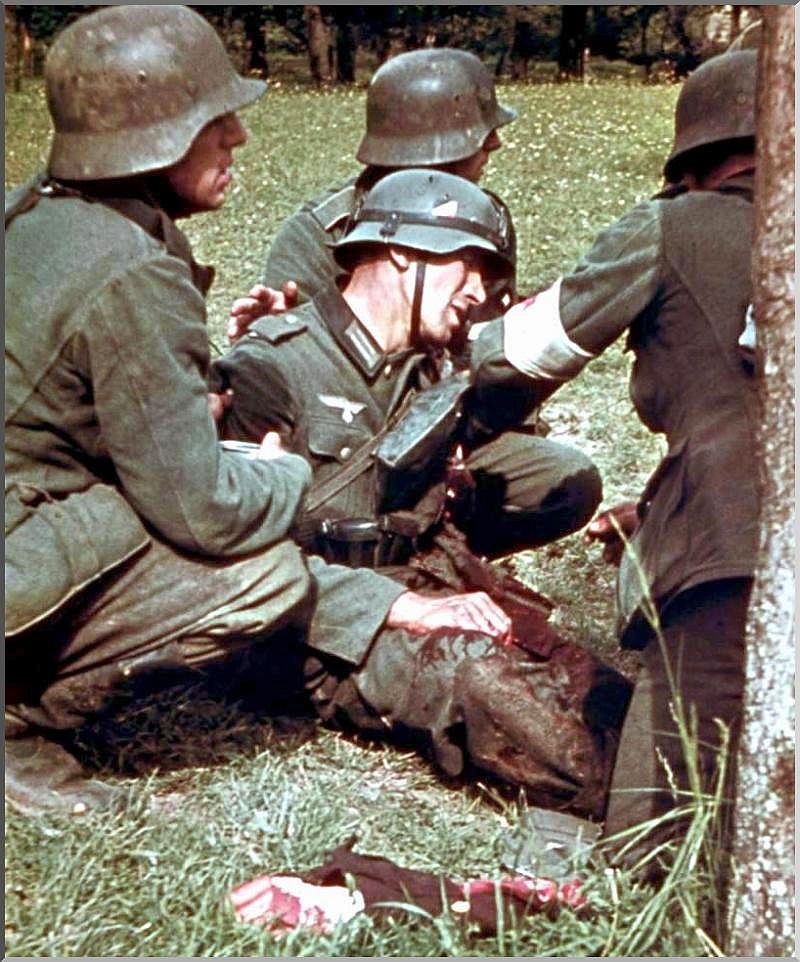
This rare—and very intense—color photograph was taken in Russia in 1942 and shows an injured German soldier on the Eastern Front.

Fellow German soldiers have come to the aid of the wounded man.

Their efforts may have been in vain. Is not the wounded soldier’s left arm at the very bottom of the photograph?

Wednesday, May 04, 2011

Marriage And Class In America

Among the upper-middle class, marriage continues to be the norm. Among the lower-middle class, though, marriage rates have collapsed.

This has created a cultural gulf between classes in America that affects every aspect of life, and arguably threatens the cohesion of America itself . . .

In 1960, 88 per cent of upper-middle-class adults were married. In 2010, the figure was 83 per cent, a small drop.

But among the working class, 83 per cent of whom were married in 1960, the figure today is 43 per cent . . .

Children pay an even higher price for the absence of marriage. As [author Kay] Hymowitz writes: “If you want to analyze the inequality problem, start with the marriage gap. Virtually all—92 per cent—of children whose families make over $75,000 per year are living with married parents. On the other end of the income scale, the situation is reversed: only 20 per cent of kids in families earning under $15,000 live with both parents.”

The evidence is overwhelming. Parental behavior—that is, choosing, or not, to wait until marriage to have children—is the key determinant of success for children.

“Children of single mothers,” Hymowitz writes, “have lower grades and educational attainment than kids who grow up with married parents, even after controlling for race, family background, and IQ.”

And it isn’t just the presence of a man in the house that makes married families more successful. “Poverty rates of cohabiting-couple parents are double those of married couples, even controlling for education, immigration status, and race.”

Mona Charen, writing in National Review on 29 April 2011

Tuesday, May 03, 2011

Reception


Magda Goebbels, Wilhelm Furtwangler, Joseph Goebbels and Zitla Furtwangler at a 1940 reception for members of the Reichskulturkammer (“State Bureau Of Culture”).

Despite the fact that she had been legally separated from her husband since 1931, Zitla Furtwangler continued to perform public duties for the socially-awkward Wilhelm for another twelve years—hence her appearance at this 1940 reception sponsored by Goebbels.

Zitla provided assistance, openly, to numerous Jewish musicians throughout the period of National Socialism—indeed, Zitla may have done more in this regard than her husband—and Zitla continued, selflessly, to perform innumerable tasks for her husband long after the separation. She did so simply because she knew that Furtwangler had no one else trustworthy on whom he might rely.

When Furtwangler requested a divorce in 1943 so that he might remarry, Zitla immediately consented—and yet she continued to devote her time to providing assistance to Furtwangler’s musicians for the remainder of the war.

It is regrettable that Zitla has been written out of history books. She very well may have been a remarkable woman.

Zitla’s disappearance from modern accounts of Furtwangler’s life is largely due to the initiatives of Furtwangler’s second wife, Elisabeth, the most highly-skilled professional widow since Cosima Wagner.

Having asserted control over her husband’s legacy at the time of his death, Elisabeth has never allowed anyone but herself to feature in the Furtwangler story. In Elisabeth’s eyes, there is no room for anyone else.

So long as Elisabeth is alive—and she remains living at the age of 100, still occupying the home Furtwangler bought near Saint Moritz in 1922—and so long as Elisabeth can continue to bribe journalists with old personal photographs and ancient handwritten memorabilia, no reliable biography of Furtwangler will be allowed to appear.

In fact, I suspect that Furtwangler’s only legitimate son will have to die, too, before a probing account of Furtwangler’s life may be attempted.

By that time it may be too late.

Furtwangler In America II

Wilhelm Furtwangler’s second set of appearances in the United States occurred in 1926.

Between February 11 and April 2 of that year, Furtwangler conducted the New York Philharmonic in thirty-one concerts, more than three times the number of concerts he had led the previous year during his first American engagement.

Furtwangler arrived in the United States on the S.S. Albert Ballin of the Hamburg-America Line on February 10, the day before the first of his New York Philharmonic concerts.

In 1925, Furtwangler had traveled to the U.S. alone. In 1926, he was accompanied to the U.S. by his first wife, Zitla Lund, a Danish woman considered at the time to represent the height of sophistication, elegance and beauty.

Furtwangler and Lund had married in 1923. The marriage was not a happy one. The two became legally separated in 1931 and were divorced in 1943.

In the photograph below, Furtwangler and Lund are seen shipboard on the 1926 trans-Atlantic crossing. It is unknown whether the photograph depicts Furtwangler and Lund bound for America or on the return voyage to Europe.


Of the thirty-one concerts in 1926, twenty-five occurred in Manhattan and Brooklyn: Carnegie Hall was the site of twenty-one concerts; the Brooklyn Academy Of Music was the venue for two concerts; a single concert was held at the Waldorf Astoria Hotel; and a single concert was offered on the stage of the Metropolitan Opera House.

In 1926, Furtwangler also conducted the New York Philharmonic in six out-of-town concerts, all part of a brief Eastern tour by the orchestra: two concerts at the Syria Mosque in Pittsburgh; one concert at the Academy Of Music in Philadelphia; one concert at the Lyric Opera House in Baltimore; one concert at the National Theatre in Washington, D.C.; and one concert at the Strand Theatre in Reading, Pennsylvania.

In the 1920s, visiting orchestras in Washington appeared at the National Theatre. It must have been the only suitable venue in Washington at the time (DAR Constitution Hall was not to open until 1929). Most persons undoubtedly find this fact remarkable today—and most persons who have attended performances at the National Theatre surely were unaware that Furtwangler twice appeared onstage there (he was to lead another concert in the theater the following year).

And whoever might have known that Furtwangler once conducted a concert in Reading, Pennsylvania? This fact must astonish everyone.

Furtwangler’s 1926 American repertory is listed below.

If Furtwangler offered more than one performance of a listed work, asterisks note the total number of performances. Works heavily-asterisked signify that the works were performed during the New York Philharmonic’s brief five-city, six-concert tour under Furtwangler.

If a listed work had been performed during Furtwangler’s 1925 visit to America (as was the case with four works, one each by Beethoven, Schumann, R. Strauss and Wagner), the repeat is noted.

Beethoven
“Egmont” Overture ******
“Leonore” Overture No. 3 **
Piano Concerto No. 4
Symphony No. 3 ("Eroica") **
Symphony No. 7 [Repeat]

Berlioz
Le Corsaire Overture **

Brahms
Hungarian Dances Nos. 1, 3 and 10 ***
Symphony No. 4 *******
Violin Concerto

Bruckner
Symphony No. 4 **

Dvorak
Hussite Overture
Symphony No. 9 (“From The New World”) **

Handel
Concerto Grosso, Opus 6, Number 5 **

Haydn
Harpsichord Concerto In D Major, Opus 21 **
Symphony No. 88 *****

Mendelssohn
Violin Concerto

Mozart
“Le Nozze Di Figaro” Overture **
Piano Concerto No. 26 (“Coronation”) **
Serenade No. 13 (“Eine Kleine Nachtmusik”) ****

Ravel
Rapsodie Espagnole ***

Respighi
Ancient Airs And Dances, Suite No. 2 ****

Saint-Saens
Cello Concerto No. 1

Schoenberg
Verklarte Nacht

Schubert
Entr’acte, Act II, From “Rosamunde”

Schumann
Piano Concerto ** [Repeat]
Symphony No. 1 (“Spring”) ****

J. Strauss
Emperor Waltz

R. Strauss
Symphonic Interludes From “Intermezzo” **
Symphonia Domestica **
Till Eulenspiegel ***** [Repeat]

Tchaikovsky
Symphony No. 6 (“Pathetique”) *****

Valentini
Cello Suite **

Wagner
“The Flying Dutchman” Overture **
“Die Meistersinger” Prelude ********* [Repeat]

Weber
“Euryanthe” Overture **
Invitation To The Dance
“Oberon” Overture **

The Valentini in question was Giuseppe Valentini (1681-1753), a minor master of the Italian Baroque. The composer’s so-called “Cello Suite” was probably a pastiche work created from Valentini’s many sonatas for cello and keyboard by cellist Hans Kindler, soloist for the performances. Kindler would take up the baton himself the following year; in 1931, Kindler would go on to found Washington’s National Symphony Orchestra.

Monday, May 02, 2011

A Portrait Of Familial Bliss


This cozy family portrait, from 1938, depicts Magda Goebbels with Harald Quandt, Magda’s son by her first marriage, and five of her children with Joseph Goebbels (a sixth was to follow in 1940).

The photograph was pure propaganda. It was intended to portray Magda and her children as the embodiment of family ideals under National Socialism. Until May 1, 1945, on which date Magda and Goebbels murdered the six Goebbels children and afterward took their own lives, the Goebbels clan was a constant feature of German magazines and newsreels, invariably presented as the perfect German family.

Such depictions did not reflect reality. Goebbels, a perpetual philanderer, was anything but a family man. In fact, it was in 1938, the year the photograph was made, that Magda first pressed for a divorce from Goebbels, claiming that her husband’s many affairs made it impossible for her to continue the marriage.

Hitler forbade a divorce. Hitler wanted the façade of a happy, thriving Goebbels family to be maintained—and not solely for propaganda purposes.

It would, Hitler ruled, reflect poorly upon himself for one of his chief ministers—and his only minister with a large family—to be involved in a marital breakup.

Hitler’s decree that the Goebbels family remain together was accepted—and, to assuage Magda’s hurt feelings, the German leader saw to it that a Czech film actress with whom Goebbels had become deeply infatuated was escorted out of the country.

In the photograph, Magda’s smile looks forced—and the children appear to be profoundly unhappy if not outright miserable. Harald, only seventeen years old in 1938, looks old enough to be Magda’s father.

That Goebbels himself was not included in the photograph—and Goebbels indeed generally was included in such photographs—suggests that the sitting occurred during a period in which the Goebbels marital fortunes were at a particularly low ebb.

The deaths of everyone in the photograph except Harald occurred sixty-six years ago yesterday.

Had the Goebbels children been allowed to live normal life spans, most—perhaps all—would be alive today.